The holisticselling Newsletter (#5)
Published on LinkedIn on July 2, 2025
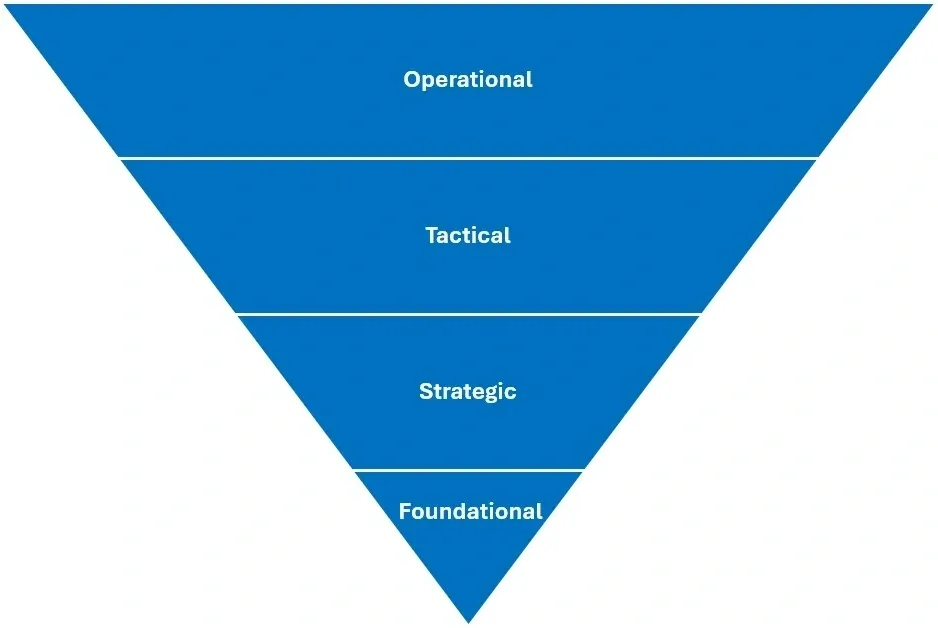
Just to ground us before we move forward, let me restate that the purpose of the holisticselling framework is to align all organizational processes and functions towards supporting your frontline team members to deliver the right outcomes to your customers and prospects. In order to achieve success with a holisticselling mindset, we need to ensure that the company is synchronized across 4 different levels:
- Foundational level (covered in the June 4 newsletter)
- Strategic level (covered in June 11, June 18 and June 25 newsletters)
- Tactical level
- Operational level
That is the core of the holisticselling framework. These levels are organized in the form of an upside-down pyramid, which puts your customers and frontline team members at the top. It empowers your frontline team members to deliver the right outcomes to your customers and prospects at every moment of truth throughout their entire journey.
Today, we will start covering the tactical level of the holisticselling framework. As we get move up through the levels of the upside-down pyramid, it becomes even more important to align and synchronize all the functional capabilities with a focus on empowering your frontline team members to deliver extraordinary outcomes to your customers and prospects. That needs to be the guiding principle. I keep reinforcing this because I have seen numerous examples of companies losing their way and allowing functional metrics and processes to become the driving force of each function – and losing the forest for the trees by allowing each function to pursue its own sub-optimal goals.
We will take a look at how the functional tactics and capabilities support the overall goal of the holisticselling framework – but before we do so, let’s acknowledge the elephant in the room: the pervasive role AI will play in all customer-facing roles going forward. I will discuss this within each functional area. It is however critical to understand that AI will only generate positive results if it is based on the proper foundation. Using AI to automate disconnected functional processes will fail. For example, if you feed poor inputs into your company-proprietary AI LLM, it will generate outputs that will reinforce and automate bad behavior. That is why the holisticselling methodology needs to be implemented before you consider deploying AI tools! As stated in a whitepaper from XForce Management (‘Embedding AI into your B2B Sales Engine’), “a foundational framework ensures your AI agents are guided in the right way, sparing your organization the cost of mixed messages, processes and outcomes”. I would recommend considering holisticselling as that foundational framework.
Message #13: Before deploying AI, implement the holisticselling framework first to ensure that all your functional processes are aligned and synchronized to enable your frontline team members to deliver extraordinary outcomes to customers and prospects. If you don’t, AI will automate sub-optimal processes and deliver sub-optimal results.
The move from software-as-a-service to AI agents-as-a-service is a revolution that will rock every software company – how products are coded and released, how the sales team will interact with customers and prospects, how the customer success team will help customers get value from their investment, etc. – it will impact all of it, across the entire customer lifecycle.
That brings us to a number of DOs and DONTs that should be considered as you look to adopt AI to improve your B2B sales success:
DO
- Build the right foundation first – a foundation that is built on delivering successful business outcomes to customers at every moment of truth.
- Understand which problems you want to solve with AI (and with which type of AI – machine learning, deep learning, natural language processing, Gen AI, etc.).
- Buy or build a complete AI system for your frontline team members (sales reps, solution consultants, SDRs/BDRs, marketers, professional services, customer success managers, support, etc.) – with one single focus: deliver the right outcomes to customers and prospects at every moment of truth.
- Identify the use cases you want to include in your AI deployment.
- Be clear about the metrics AI will improve, and measure progress against these metrics as you start deploying your AI strategy.
- Ensure that you have one AI owner for the enterprise, who should report to the CEO and sit on the executive leadership team.
- Integrate AI into the ways of working of your frontline customer-facing team members. AI needs to be imbedded into their workflows.
- Make it a top priority – companies that do not adopt AI to improve their sales performance and customer success with a sense of urgency will be left behind.
DONT
Implement AI without being clear on your goals and desired outcomes.
As you start building (or partnering with a 3rd party to build) your company-proprietary AI LLM, you will need to make sure you include several complementary types of data, such as:
- Internal data: product information, marketing assets, go-to-market strategy, sales playbook, sales enablement content, customer success and support content, domain expertise, legal and compliance data.
- External data: competitive information, market trends, industry trends, technology trends, sales methodology and tools, customer segmentation, target customer profiles, persona-based outcomes, prospects and customer lifecycle stages.
Unless you have a dedicated AI team that can build and maintain your AI LLM over time, you may want to consider partnering with a specialized 3rd party AI firm to ensure your success. One such example is Pangea Summit, a company founded by ex-Oracle industry experts, which has developed a complete AI methodology to enable your frontline team members to deliver tailored messages to audiences of one, at scale, with an emphasis on human-to-human connections. While many companies may be tempted to do it alone, the continuous flow of AI innovation may make it difficult for most to succeed without partnering with a specialized 3rd party AI firm.
We need to realize that, at the end of the day, most companies will leverage AI to uplevel their ability to deliver personalized, tailored and human connections to their customers and prospects. Those that don’t will definitely lose out. What will however make a difference is:
- Your purpose and values, which define the character of your enterprise and determine how you interact with customers and prospects. For example, you can have the best AI strategy, but, if you don’t practice empathy, humility and transparency with your customers and prospects, that strategy will fail.
- Your domain expertise, which determines the quality of the advice you will deliver to your customers and prospects. They will engage with you because they can trust the expert advice you will provide to them throughout their journey. That domain expertise is uniquely yours.
Message #14: Assess your ability to build and maintain your own comprehensive AI LLM methodology. Consider partnering with a specialized 3rd party and focusing on what will truly make you differentiated in the marketplace: your values and your domain expertise.
Why is this critical to B2B selling? Because AI will have a profound impact on your ability to build personalized, relevant and human connections with your customers and prospects. It will change everything, from how you onboard and train your customer-facing team members to how these team members engage with customers and prospects and leverage that engagement to build the customer advocacy you need to fuel your growth.
One last thought for today about AI. I have seen many posts about building an AI LLM for use by your customer-facing team members to help them deliver better outcomes to customers. That notion seems to be gaining ground very quickly. What I have seen less of is building an AI LLM for direct use by your customers to help them achieve better outcomes with your solutions. What if you could load all your product specifications, the resolutions of all your support tickets, your training materials, etc. into a LLM and let your customers question that proprietary model to optimize their use of your solutions – by themselves?
Questions for you:
- Is your company looking to leverage AI to deliver personalized messages to customers and prospects, at the individual stakeholder level, relevant to each stage of their lifecycle?
- Have you established the right foundation first before implementing your AI strategy – one built on empowering your frontline team members to deliver the right business outcomes to customers and prospects every step of the way?
- Are you looking to build your own AI methodology and tools, or partner with a specialized 3rd party?
- Are you focused on building a comprehensive (aka holistic) AI strategy or are you moving forward with adopting limited scope AI tools at the functional level?
- Are your AI tools imbedded in the workflows that govern the work of your frontline team members?
- Are you thinking about deploying a LLM model that could be used directly by your customers to increase the value they get from their investment in your solutions?
Next week, we will start exploring the capabilities and tactics required to enable the holisticselling framework across all functions of the enterprise. As always, your comments are welcome!
Tags: