The holisticselling Newsletter (#12)
Posted on LinkedIn on August 20, 2025
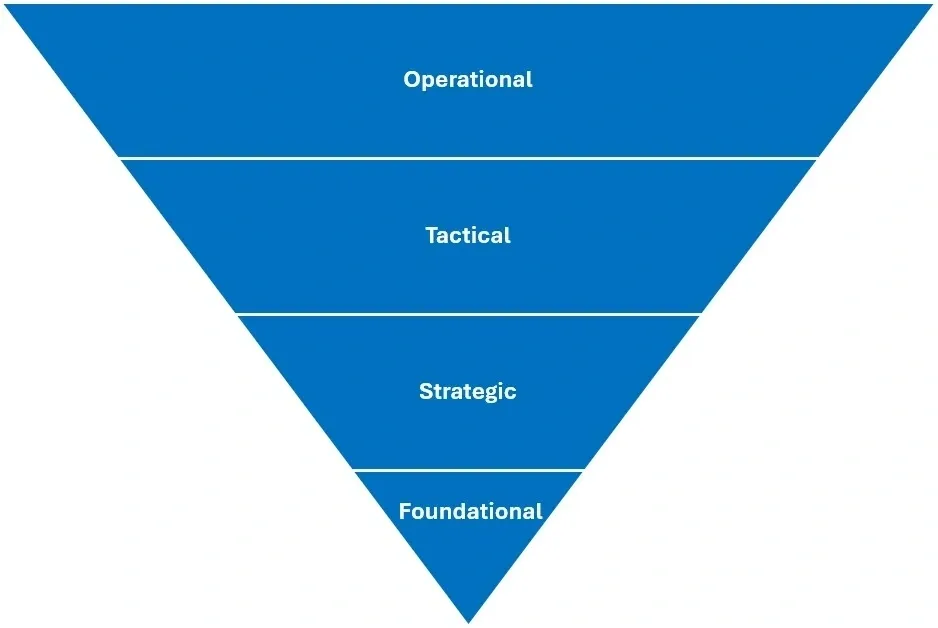
As you may have noticed, I like to start each newsletter by restating the purpose of the holisticselling framework: to align all organizational functions and processes towards enabling your frontline team members to deliver extraordinary experiences and outcomes to your customers and prospects. In order to achieve success with a holisticselling mindset, we need to ensure that the company is synchronized across 4 different levels (see the graphic above):
- Foundational level
- Strategic level
- Tactical level
- Operational level
As we start digging into the operational level of the holisticselling framework, here is a quick recap of the newsletters published so far:
- Foundational level – purpose, values and leadership
- Strategic level – business model
- Strategic level – branding, reputation and core value proposition
- Strategic level – product management, go-to-market, value, balanced scorecard and organizational design principles
- Tactical level – AI
- Tactical level – go-to-market
- Tactical level – sales enablement
- Tactical level – marketing
- Tactical level – sales/business development
- Tactical level – solution consulting and value engineering
- Tactical level – partner management
The operational level of the holisticselling framework can be broken down into 4 components (see the graphic below):
- Lead generation. Lead identification, nurture and conversion.
- Pipeline management. Pipeline growth, maturity, velocity and conversion.
- Sales execution. Opportunity management from engagement to close.
- Account management. Customer management from implementation to advocacy.

Let’s start today with lead generation, which is the foundation of your success at the operational level. This is ground zero. Without the right volume of quality leads generated from either existing customers or prospects, you will have a hard time meeting your bookings and revenue goals. And yet, in my experience, it is an area of constant trial and error that delivers inconsistent results.
This topic alone could fill many pages. My goal is to generate insights that may be useful to you, so let’s use a simple categorization to start our analysis. As mentioned in the newsletter #9, it is useful to break down the types of leads between:
- Inbound leads from customers.
- Outbound leads from customers.
- Inbound leads from prospects.
- Outbound leads from prospects.

I would highly recommend tracking your leads based on that simple categorization. Why? Because each lead type delivers different results and needs to be managed differently. For example, inbound leads tend to come in later in the buyer journey, so you have less influence on helping the customer define their need state and solution requirements. Outbound leads are harder to find, but they give you the opportunity to establish yourself as a trusted advisor earlier in the buying cycle.
To elaborate on this, I assessed the lead types based on 4 criteria: (a) the buyer journey stage (earlier is better), (b) the typical deal value (higher is better), (c) the conversion rate from lead to deal (higher is better) and (d) the cycle time (shorter is better). See the table below.

This simple framework will help you understand the pros and cons of each lead type. Feel free to change the ratings as you see fit. Based on my ratings, the most valuable type of leads would be outbound leads from customers. Why? Because you can shape the buyer’s PoV around transformational needs revealed by your relationship with them, which leads to higher conversion rates and higher average deal sizes. On the other side, if you rely mostly on inbound leads from prospects, you are likely going to chase many deals you will not win.
How can you use this categorization to optimize your lead flow?
- First, you need to analyze all the metrics tied to each type: (a) how many leads are you generating, (b) what is your conversion rate from lead to deal, (c) how long is the cycle from lead to deal and (d) what is the average deal size.
- Here is a table that summarizes a set of sample data:

- These data indicate that you would generate $33M of annualized bookings, with 61% coming from your customers ($20M) and 39% coming from your prospects ($13M). Are these the right numbers for your business? Do you agree with the value mix generated by the 4 lead types?
- They also indicate that the average annualized value for each lead. For example, an outbound lead from a customer is worth $80k, but an inbound lead from a prospect is only worth 25% of it, or $20k. Should you therefore not work harder at generating outbound leads from customers?
- You also need to look at the cost and resource side of the equation. The sample data above indicate that you generated 1,000 leads per year. Can you estimate the average cost to generate, nurture and convert each lead type? The type of cost you should look at are, for example, marketing costs, SDR/BDR costs and sales cycle costs.
- Once you have calculated these costs, can you assess the value/cost ratio for each lead type? Is there a way to reallocate your total cost towards lead types that have a better value/cost ratio, and therefore improve your overall productivity?
I realize that this type of analysis requires a dedicated effort, which I have not seen many companies undertake. Most tend to keep doing what they are doing without seeking to understand how to optimize their mix. For example, you may realize that inbound leads from prospects have the lowest value and still generate heavy costs (it is expensive to respond to large RFxs). You may also realize that outbound leads from customers have the highest value and, comparatively speaking, come at much lower costs. Would it then not make sense to put a plan together to significantly increase the number of outbound leads from customers by improving your customer advocacy and training your account managers to find transformational needs within their customer base?
As you start the process of optimizing your lead mix, let’s also take a look at the top 10 enablers that will ensure the success of your lead generation efforts (in no specific order):
- Branding and reputation. Branding is what you tell the market about you, and reputation is what the market says about you. The more the two are aligned, the more likely you are to create trust with customers and prospects. Both are essential building blocks to help you generate quality leads, both inbound and outbound.
- Customer advocacy. We all know this: happy customers will buy more from you and will act as references for other companies. Yet, very often, the advocacy program seems underfunded and buried under a myriad of other marketing programs. Nothing is more important to your lead generation success than customer advocacy. Treat it as such. A leading indicator of customer advocacy is the ability to measure and improve the adoption and utilization of your solutions, and the value they provide to your customers. This needs to be on the radar of your account management team at least on a monthly basis.
- Early detection of leads. As discussed earlier, engaging with accounts in the ‘dark funnel’ will put you in a position to influence their PoV on the problem they need to address and the solution they need to deploy. This will in turn convert to a higher probability of success. I think it is fair to say that finding the right accounts and personas in the dark funnel is still very much a work in progress. Companies like 6sense and Demandbase have specialized in finding the right leads in the dark funnel, but their results are still a mixed bag, due to generic and inaccurate data, ineffective lead identification and overall frustration with the trial-and-error process. I would encourage you to leverage the set of solutions that will give you the greatest ROI in this area (and there are 10-15 companies in this space to choose from). Invest in this space.
- Impact of AI. What if you could aggregate your internal data and external data from companies like 6sense and ZoomInfo into your company-proprietary AI LLM in order to refine your lead generation approach? What if you could then make it available to your SDRs, BDRs, sales reps and account managers to determine which accounts and personas they should target? This could have a massive impact on your lead generation success.
- Optimization of lead sources. Your leads are typically generated by marketing and sales, but they can also come from partners and from the customer success management team engaged in your customers. Partner-sourced leads typically convert at a higher rate but may only represent 5-10% of your total. Marketing leads may account for 35-40% of your total but typically convert at a much lower rate. Identify which lead source(s) gives you the best results and invest in increasing its relative importance.
- Quality of your nurture process. Once a lead has been identified, nurturing that lead and converting it into an opportunity is a difficult process. First of all, it is important to understand at which stage in the buying cycle the lead came from, and to adapt your message to that stage. For example, if a company is still in the early phase of understanding the problem they need to solve, sending them information about your products would be counterproductive. Instead, you should send them thought leadership information about that problem, act as a trusted advisor and help them refine their PoV. As you progress, you will need to keep adapting your messaging to each stage of the buying cycle. Second, you need to adapt your communication style to the persona you are targeting. Adopting a generic style is akin to throwing stuff on the wall to see what sticks. This requires a detailed understanding of each persona you are targeting. Third, you need to adopt the right nurture cadence, mix and length to trigger attention and interest from your target personas. For example, schedule 10 touches every 3 days for 30 days across a number of channels. Test your nurture process continuously to find your sweet spot.
- Cross-channel coordination. This brings up the need for close coordination between marketing, sales/business development and sales/account management. Ideally, your marketing campaigns and account-based marketing programs need to be synchronized with your BDR, sales and account management outbound effort. Your target personas need to be surrounded by a coherent omni-channel strategy consisting of digital ads, events, emails, phone calls, LinkedIn messages and other tactics.
- Ongoing coordination between SDRs/BDRs and sales reps/account managers. The SDRs and BDRs should schedule a weekly touchpoint with the sales reps and account managers they support. Both team members should follow a regimented process to determine (a) which accounts and personas to go after, (b) how the leads are progressing and (c) who will do what to drive it forward. That coordination is essential to optimize the process.
- Qualification. Lead qualification is typically relying on a simple system like BANT. These 4 qualifiers (budget, authority, need and time) are not always easy to assess, depending on the type of lead and the stage in the buying cycle. For example, an inbound lead from a prospect who already has defined the problem and the solution will be much more advanced than an outbound lead catching a prospect early in their investigation process. While BANT can be useful, what is more telling is the degree of engagement of the prospect or customer. You need to make sure your prospect or customer is actively engaged before qualifying the lead. In other words, make your qualification customer-centric. Your internal assessment is irrelevant if the customer or prospect is not willing to talk.
- Discipline, discipline, discipline. Nothing is more important than making sure your sales reps and account managers make lead generation a priority every day of every week. It should represent 20-25% of their time. Your pipeline will quickly deteriorate if you don’t focus on this as a daily priority.
Message #22
- Monitor your leads by type (inbound/outbound v customer/prospect). Track their metrics (e.g. conversion rate, cycle time, average deal value) to determine the relative value of each lead type. Use that data to optimize your lead generation process.
- Invest to build your brand and protect your reputation. Make sure both are telling the same story.
- Invest in your customer advocacy program. Make it a top priority.
- Tailor your messaging to the specific situation of your target persona. Generic messaging does not work anymore. You need to be surgical.
- Synchronize your marketing campaigns with your BDR, sales and account management cadences. Surround your prospects with cross-channel messaging.
- Ensure tight collaboration between your SDRs/BDRs and your sales reps/account managers.
- Make sure your lead qualification process is customer-centric. Ensure that the prospect or customer is actively engaged before you qualify the lead.
- Make lead generation a daily habit. Discipline is critical.
- Leverage your company-proprietary AI LLM to find the right targets and tailor the messaging throughout the nurture process.
Why is this critical to B2B selling? Because lead generation is the foundation of your success at the operational level of the holisticselling framework. Without the right volume of quality leads generated from either existing customers or prospects, you will not be able to meet your bookings and revenue goals.
Questions for you:
- Do you monitor your leads by type (inbound/outbound v customer/prospect)? Do you track their metrics to determine which lead type(s) you should prioritize?
- Do customers and prospects trust your brand and your reputation? If companies do not trust that you will help them succeed, they will not engage with you.
- How strong is your customer advocacy program? Are your customer advocates engaged in growing your business?
- Have you invested in finding leads in the ‘dark funnel’? How is that program working for you? What improvements could you make?
- Have you built a company-proprietary AI LLM by combining internal and external data sources to help you find the right targets and tailor your messaging at every stage in the buying cycle?
- Are your marketing, BDR, sales and account management functions synchronized to select and engage with the right targets?
- Are your BDRs and SDRs coordinating the lead generation process with their sales reps and account managers every week?
- Is your lead qualification process customer-centric? Is the customer or prospect actively engaged in the process?
- Have you tested and optimized your nurture process? Do you know which cadence, mix and length will trigger the most attention and interest from your target personas?
- Did you make your lead generation process a daily and weekly habit for your sales reps and account managers? Do you track how much time they spend on lead generation every week?
As mentioned above, lead generation is a complex topic. I trust that the content I focused on in this newsletter can help you improve the results you are getting from this critical investment.
Next week, we will discuss the second part of the operational level of the holisticselling framework: pipeline management. Until then, feel free to connect and share your thoughts on what I have shared with you so far!
This newsletter starts the review of the operational level of the [holisticselling](https://www.linkedin.com/company/holisticselling/) framework and focuses on l*ead generation*.
Tags: