
The holisticselling Newsletter (#15)
Posted on LinkedIn on September 3, 2025
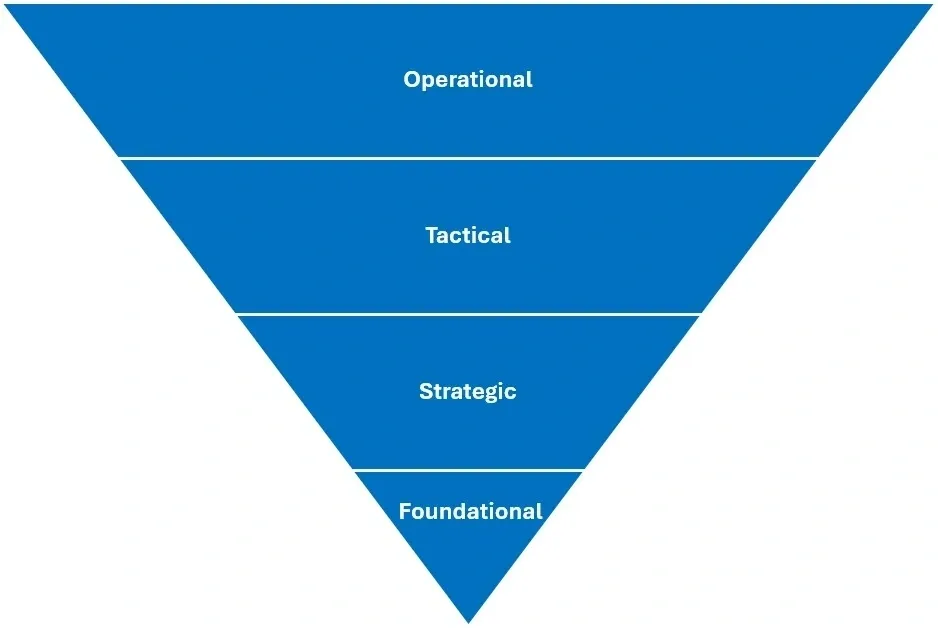
The holisticselling framework was created to remind us that all your organizational functions and processes need to be aligned to enable your frontline team members to deliver extraordinary experiences and outcomes to your customers and prospects. That alignment needs to be synchronized across 4 different levels (see the graphic above):
- Foundational level
- Strategic level
- Tactical level
- Operational level
The operational level is where your frontline team members engage with your customers and prospects. It consists of 4 components (see the graphic below):
- Lead generation. Lead identification, nurture and conversion.
- Pipeline management. Pipeline growth, maturity, velocity and conversion.
- Sales execution. Opportunity management from engagement to close.
- Account management. Customer management from implementation to advocacy.

We started exploring the operational level with the newsletter #12. Today, we will dig into account management – which will close the operational level of the holisticselling framework.
I have had the privilege of working with 2 great account management teams at Infor and JAGGAER , and I witnessed firsthand that the work done by account managers is foundational to the company’s success. This is where the magic happens to convert as many customers as possible into advocates.
The responsibilities of an account manager (AM) are complex and sometimes overwhelming, so I decided to break them down into 3 layers: strategic, commercial and operational. We will review the key activities and metrics for each category.
The strategic role includes the following activities …
- Strategic account planning. Every account should have an updated account plan in place. That account plan should include the defensive (how to protect the revenue) and offensive (how to expand the revenue) playbook for that account. It also needs to be converted into specific actions to make sure the plan is executed. These actions should be reviewed on a quarterly basis to ensure progress against the plan.
- EBRs (Executive Business Reviews). The AM needs to plan the adequate sequencing of EBRs across her/his accounts every quarter.
- Executive relationships. Maintaining a regular and ongoing communication between executives is key to long term success. Executives change over time, so this will need to be reset multiple times throughout the customer life cycle.
- Advocacy. This works both ways. The AM needs to be the advocate for the customer internally. Conversely, the goal is to transform the customer into an advocate for your company.
… and can be measured with the following key metrics:
- Account plan built and updated for each account under management.
- Number of EBRs.
- Number of executive touchpoints.
- Advocacy contributions by the accounts under management.
- NPS (Net Promoter Score), which is a customer loyalty metric that measures the likelihood of your customers recommending your company’s solutions to a peer or colleague.
The commercial role includes the following activities …
- Renewals. While renewals only happen every few years (depending on the duration of the contracts), they need to be actively managed on an ongoing basis. A renewal has a greater risk of failure when it becomes a short term project at the end of the contract term.
- Upsells and cross-sells. On top of renewing the account, the AM also needs to grow it by way of upsells and cross-sells. Upsells tend to happen more frequently but typically have a low average deal size. Cross-sells are more critical as they demonstrate the customer’s willingness to expand your footprint. Ideally, the cross-sell sales cycles target transformational projects vs. incremental module-level expansions. Cross-selling should be a natural extension of the growth strategy (offensive playbook) you outlined in your account plan.
- Sales execution. The AMs need to adopt the same best practices as the net new sellers, which we discussed in the newsletter #14. Implement a customer-centric sales process, implement the right opportunity tracking tool and develop the AMs’ sales skills.
… and can be measured with the following key metrics:
- Net and gross retention. Ideally, your net retention rate should be > 95% and your gross retention rate should be > 110% (best-in-class B2B software companies can reach > 120%).
- Conversion rates. Maintaining quarterly conversion rates > 30% in aggregate is the goal. We should expect the following conversion rates by type of opportunity: renewals > 90%, upsells > 60%, cross-sells > 40% for incremental deals and > 25% for transformational deals.
- Forecast accuracy. This greatly depends on the predictability of your quarterly conversion rates. If you can predict a conversion rate of 25-35%, you can estimate early in each quarter that a $10M pipeline early in the quarter will deliver between $2.5M and $3.5M of bookings by the end of that quarter. Forecast accuracy needs to be measured every quarter at the AM level.
The operational role includes the following activities …
- Customer health management. AMs need to constantly monitor the adoption and utilization of the solutions by the customer after implementation and compare them to the goals jointly set with the customer. This will help you spot any trends that would need to be discussed with the customer.
- Value realization. As we discussed in the newsletter #10, I highly recommend measuring the value your customer gets from your solutions after implementation. This requires an investment in value engineering, but that investment will pay significant dividends in terms of customer expansion and advocacy.
- Issue resolution. As the main point of contact for the account, AMs will be called upon to help resolve customer issues. Other teams, such as customer success management, professional services, support, product development and engineering, need to carry to burden of getting the issues resolved, but the AM plays a critical ‘quarterback’ role to ensure all the issues are escalated and all resources are being deployed as needed.
- Compliance. AMs also need to make sure the customers operate within the walls of their agreement. This is why measuring adoption and utilization on a monthly basis is important. It is always preferable to catch and resolve potential compliance issues before they happen.
- Internal collaboration. The AMs need to excel at coordinating all the touchpoints with their customers. It requires a significant level of collaboration with functions like marketing, business/sales development, sales operations, product management, engineering, legal, finance, professional services, customer success management and support.
… and can be measured with the following key metrics:
- Adoption and utilization. Measured against the joint goals set up with the customer.
- Value realization. Measured against the joint goals set up with the customer. We talked about the importance of value engineering in the newsletter #10. I would highly recommend building capacity to work with your customers (or a cross-section of them) to measure value after implementation.
- Issue management. Number of unresolved issues, time to resolution.
- Customer health score. This is a composite measure that predicts the likelihood of retention, expansion or churn of an account. You first need to determine which measures to include and then define their relative weight to come up with the aggregate health score.
As you can see, the AM role is very complex across all 3 layers (strategic, commercial and operational) and can be measured by as many as 12 metrics. It is important to maintain a balance scorecard approach to monitor performance and identify areas for improvement.
To compound the degree of difficulty, not all accounts should be treated the same way every quarter. I recommend to have each AM categorize her/his accounts at the start of every quarter into what I would call ‘high touch’, low touch and ‘tech touch’ accounts (to follow the terminology used in the ‘Customer Management’ book by Nick Mehta, Lincoln Murphy and Dan Steinman). The ‘high touch’ customers are the ones that will drive 80% of your results for that quarter. They should be handled as the top priority. The ‘tech touch’ accounts are the ones that can be put on a maintenance mode for that quarter. The ‘low touch’ accounts sit in the middle. Here is the recommended ratios as well as the recommended percentage of time dedicated to each category:

It is important to keep in mind that some accounts may move from one category to another every quarter. For example, an account could be ‘high touch’ one quarter and ‘tech touch’ the next because you are working with them this quarter to close a significant renewal of transformational cross-sell deal.
Now that have identified the responsibilities of an AM, the next question is: How much capacity do you need? How many existing customers should you assign to each AM? The answer depends on your specific parameters, such as the average ARR (annual recurring revenue) by customer and the complexity of the solutions you sell. In general, if you handle strategic customers that require constant involvement across multiple stakeholders, you may want to limit the number of accounts to 3-7 per AM. If you handle smaller customers with a limited expansion potential, an AM could handle 30-40 accounts. The middle range of 10-20 accounts would work best for AMs who have a mix of high touch, low touch and tech touch customers. For example, let’s say your total ARR is $100M, and you have 200 customers with an average ARR of $500k. If you adopt the middle range of 10-20 accounts per AM, you will need 10-20 AMs with each between $5 and $10M of ARR under management.
If your strategy is to segment your accounts (e.g. large, medium, small), I would also recommend tiering the AM role between, e.g., strategic AM, regular AM and junior AM, and follow the guidance above to determine how many accounts each tier would manage. On the other side, if your strategy is to blend accounts in each territory, I would recommend keeping the ratio to maximum 20 accounts per AM. If you go higher, you start losing the ability to focus on the strategic role of the AM, and your partnership with your accounts will be impacted over time.
One additional note on AI. Once again, your company-proprietary AI LLM will be immensely valuable to your AMs, especially if you have loaded all your internal and external data sources into the model. The AMs could interrogate the AI LLM to get timely, relevant and contextual answers to their questions before engaging with customers – every time. This is a game changer!
Message #25
- Define the roles of your AMs across their strategic, commercial and operational responsibilities. Be clear about what they will do and not do.
- Build a balanced scorecard to measure the results from the AMs’ strategic, commercial and operational activities. Use it to assess progress and uncover areas for improvement.
- Review your organization structure and determine whether you want to tier your AM organization across large, medium and small accounts, or use a blended model across all AMs.
- Ensure that you deploy the right coverage model, based on your organization structure. If you opt for a blended model (each AM having a blend of large, medium and small accounts), do not exceed 20 accounts per AM.
- Build or outsource your company-proprietary AI LLM and make it available to the AMs to enable them to find timely, relevant, contextual to any questions about their customers, so they can better protect and grow their annual recurring revenue.
Why is this critical to B2B selling? Because your account managers are responsible for protecting and growing the annual recurring revenue from your existing customers – vital role for the organization!
Questions for you:
- What is your account management coverage today? Do you have the right number of account managers to achieve the right ratio of accounts per AM?
- How did you define the strategic, commercial and operational responsibilities of your AMs?
- How do you measure your AMs’ accomplishments? Which metrics do you have in place? Have you thought about deploying a balanced scorecard approach?
- Have you implemented your company-proprietary AI LLM and made it available to your AMs to help them get timely, relevant and contextual answers to all their account-related questions?
This completes the review of the holisticselling framework. Over the course of 15 newsletters, we have covered all levels of the model. I hope that you have found some value in reading the contents of the newsletters!
So – what is next? Well, first of all, I will be off the air for 3 weeks. When I return the week of September 22, I will aggregate all the newsletters into one document, while also editing some of the contents to ensure a seamless flow throughout. Then I might decide to build it into an assessment model, which would enable the readers to test their degree of readiness against the holisticselling framework, and highlight the key areas for improvement. I may also start a podcast to engage in a constructive dialogue with selected guests. If you have any suggestions, let me know!
This newsletter completes the review of the operational level of the holisticselling framework and covers account management,
Tags: