
The holisticselling Newsletter (#14)
Posted on LinkedIn on September 2, 2025
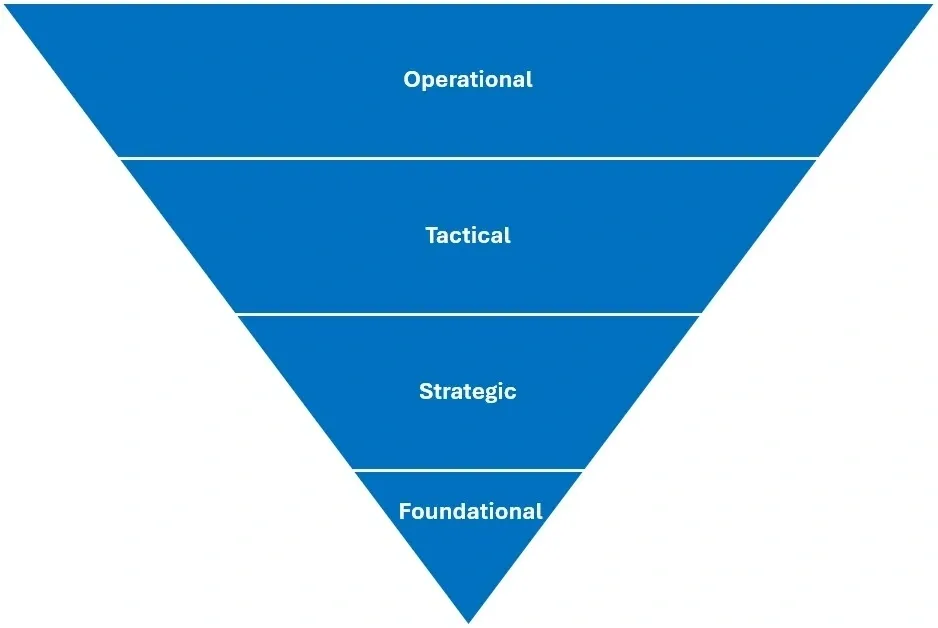
Just in case you are catching this newsletter for the first time, the purpose of the holisticselling framework is to align all organizational functions and processes towards enabling your frontline team members to deliver extraordinary experiences and outcomes to your customers and prospects. In order to achieve success with a holisticselling mindset, we need to ensure that the company is synchronized across 4 different levels (see the graphic above):
- Foundational level
- Strategic level
- Tactical level
- Operational level
We are now reviewing the operational level of the holisticselling framework, which consists of 4 components (see the graphic below):
- Lead generation. Lead identification, nurture and conversion.
- Pipeline management. Pipeline growth, maturity, velocity and conversion.
- Sales execution. Opportunity management from engagement to close.
- Account management. Customer management from implementation to advocacy.

Let’s review sales execution this week.
This is obviously an area that has been scrutinized for decades. One of the reasons why I started holisticselling is that most of the focus around B2B sales seems to be on improving the performance of the sellers, and not on how to improve the performance of the functions and processes that support the sellers. Only address the situation holistically will give you lasting and predictable results.
It has been well documented that the world of B2B selling has totally changed in the last 5-10 years, yet many companies continue to run their sales function the same way they always did. This needs to change.
Let’s first understand why B2B selling has changed:
- As mentioned before, buyers are self-educated, with 70% of research done before a seller is contacted. Also noteworthy, buyers are making important solution-related decisions, based entirely on digital interactions outside of your website. Across their journeys, buying groups spend 83% of their digital research effort not on vendors’ websites (according to Informa TechTarget). And the average buyer uses 5-6 channels through their research journey (e.g., your website, Google, analysts, specialized media, webinars, in-person events). To compound the problem, the troves of information available to the buyers very often contributes to overload and confusion. So, being able to establish your brand and control your reputation requires a complete cross-channel investment, which we discussed in the newsletter #8. You need to make sure you deliver your messages to market with surgical clarity and targeted purpose across all channels.
- Deals are more committee-driven than ever, which means reps must guide multiple departments (e.g. finance, procurement, IT, operations) towards a consensus decision. This has become more difficult as decision-makers tend to protect their access. Ensuring that you have a tailored messaging strategy for all members of the buying committee is essential to your success.
- Digital-first selling dominates. Virtual demos, digital sales rooms, and AI-driven engagement are the new norm (according to Informa TechTarget). As a result, 75% percent of B2B buyers say they prefer an entirely rep-free sales experience (according to Gartner). In such an environment, it has become more and more difficult for sellers to meet buyers in person.
No wonder that 83 percent of sales leaders say their sellers still struggle to adapt to changing buyer needs and expectations (according to Corporate Visions).
What then? What do we need to do better and different to crack the code and achieve a consistent level of sales execution excellence? Many of you reading this newsletter will have an opinion on this. Let me add my voice to the choir by elaborating on four specific topics: (1) your sales process, (2) your opportunity tracking tool, (3) your required sales skills and (4) your sales training.
Let’s dig into the sales process. I will not belabor the merits of the many sales methodologies, like Challenger Sale, Sandler or Miller Heiman. Many experts have chimed in on this over the years. I believe that all sales methodologies converge around 3 specific phases: (1) Engage, (2) Differentiate and (3) Close.

In the Engage phase, it is critical to establish rapport and connection with the buying team, in 2 sub-phases: diagnose and prescribe.
- Diagnose is all about focusing on the problem. You need to have as clear a definition of the root causes of the problem as possible before you move on to the solution. Go slow to go fast. As the saying goes, “90% of the solution is the ability to define the problem”. This idea is often attributed to figures like Albert Einstein, who is quoted as saying, “If I were given one hour to save the planet, I would spend 59 minutes defining the problem and one minute resolving it”. The statement emphasizes that understanding the problem thoroughly makes finding the solution a lot easier. On top of that, the customers will appreciate your commitment to solve for the right problem. Many buyers, however, have lost faith in this process because the sellers show up with a long list of discovery questions. A much better way to extract the root causes of a problem is to engage in a conversation with the buyer – a conversation where you lead with relevant insights to get the right to ask questions. This give and take is essential. Insight-driven conversations will leave the buyer with a sense of ‘value exchange’ with the seller. It establishes right away the framework of a win-win relationship, which will pay dividends later. Remember that offering a prescription (a solution) before having completed your diagnostic of the problem could be considered malpractice. When you go to the doctor, you want to make sure s/he first finds the root cause of your ailment before offering you a prescription. And yet, time and again, sellers engage with the buyers by either going through a list of generic discovery questions or by presenting their solution too early. This approach will not work anymore. Remember to sell the problem, not the solution. Your goal is to lead with insights to find the root causes of the problem and document the challenges and pain points associated with it. And of course, it is important to have this conversation as high in the buyer organization as you can.
- Once your diagnosis is complete, then you can turn to the prescribe phase and present your solution. Lead with your elevator pitch, expand into your capabilities and end with your proof points.
This process is similar to the sales play process we discussed in the newsletter #6. Sales plays start with a deep understanding of the customer (who) to develop the right insights and engage in a conversion to uncover the buyer’s business outcomes (why), challenges and pain points (why change, why now) before prescribing your solution and closing the loop with your proof points (why me).
Remember that people buy on emotion, then use reason to justify their decision. Early in the cycle, ABC stands for Always Be Connecting!
In the Differentiate phase, you need to create a compelling argument as to why you represent a better choice than your competitors. There are many ways to achieve differentiation. A tool that has proven useful is the ‘value wedge’ promoted by Corporate Visions. Make sure you look at all aspects of your positioning. You may have a better solution or offer a better business case, but as validated by the Challenger Sale methodology, the sales experience you deliver to your buyers is the biggest driver of customer loyalty. It is 3 times more important than your brand, your product and your service delivery and 5 times more important than your value-to-price ratio. Of course, business cases, product demos and executive connections are important, but not sufficient. Delivering a superior sales experience means designing every interaction so that buyers end up trusting that you will help them achieve the right outcomes. How do you deliver a superior sales experience? By making it about them (not about you), leading with insights, linking insights to outcomes, showing business acumen, personalizing every interaction, being highly responsive, showing empathy, reducing friction, providing clarity at all times, understanding and mapping to the personal motivations of all stakeholders and earning the right to guide them to the right conclusion. Trust is the ultimate commodity here. People buy from people they trust.
The Close phase typically starts once you have been awarded vendor of choice. If the Engage and Differentiate phases were conducted successfully, closing the deal happens as a natural part of the overall process. Problems occur when the Engage phase did not deliver the right problem, establish the right connections or build enough trust and/or when the Differentiate phase did not clearly establish why you are a better choice across all the members of the buying committee. Sometimes, additional unforeseen stakeholders show up late in the process. Sometimes, the buyer budget gets reduced or taken away late. Sometimes, one of your competitors makes a desperate attempt to reverse the decision. All of that can (and will) happen – but successfully completing the Engage and Differentiate phases will shield you against these issues and will give you a greater likelihood of closing the deal on time.
The two skills that will help you get the job done are (a) negotiation and (b) project management. Many companies do not invest enough in negotiation skills. While critical in the Close phase, negotiation happens at every stage in the buying cycle. I would recommend sending your entire sales team to a professional negotiation course. Project management alludes to the fact you need to turn this part of the cycle into a project plan (called, e.g., a Joint Success Plan or Mutual Action Plan). You need to make sure that both parties have agreed to the MAP/JSP and committed resources to execute all tasks on time. We have all seen situations where the MAP/JSP is not agreed upon with the buyer, or when tasks on the project plan are allowed to be delayed. Once again, having established the right trust-based connections with the right executives earlier in the cycle will protect you from these impediments.
Across the entire sales process, the most common shortfalls (based on my experience) are:
- Not properly qualifying the opportunity (and re-qualifying it along the way). Every interaction with the buyer is a (re)qualification proof point.
- Failing at consultative selling early in the cycle.
- Not being able to reach the key stakeholders and decision-makers.
- Not closing effectively, causing delays and lost sales.
The best way to address these shortfalls is to ensure you have a disciplined opportunity tracking tool in place. This is where the likes of MEDDIC or MEDDPICC come in. They enable you to track your progress as the opportunity moves forward. While they have been widely adopted, I have not found MEDDIC/MEDDPICC to be a very effective tracking tool. It leaves too much room for interpretation and does not completely address every facet of the sales cycle. Why is opportunity tracking so important? Because, properly implemented, it allows you to assess your chances of winning the deal – which will improve your forecast accuracy. That’s why I would recommend a more detailed checklist as a tracking tool. The checklist should include all the key activities that need to be completed at every stage, based on your sales process. If you follow the process with discipline, the right outcome will follow. If you are a seller, this is where you go to ensure everything gets done in the right sequence, at the right time. It is your true north compass. Much has been published about the value of a checklist (check ‘The Checklist Manifesto’ by Atul Gawande for reference). The key to success is to apply rigor and discipline throughout the process.
Now that you have a sales process and an opportunity tracking tool in place, let’s discuss the sales skills that need to be cultivated to increase your probability of success. Let me list a few that I found invaluable (in no specific order):
- Consultative selling. Your job as a seller is to serve your customer and deliver value that converts into a deal, so be genuinely interested and curious about their wellbeing. Put yourself in the customer shoes. Practice empathy and active listening. Build trust. Share insights. As the saying goes, the customer will not care about you know until they know that you care.
- Storytelling. When your time comes to present your solution, embed relevant proof points into your storyline. People don’t buy features, they buy outcomes. They buy stories.
- Consensus buying. As we know, buying happens by committee. You need to be able to identify all committee members and develop an approach and message that is tailored to each one of them. The most damaging way to lose an opportunity is to realize late in the process that a stakeholder you did not know about voted you out without your knowledge.
- Qualification. Use your opportunity tracking tool as your qualification filter at every stage in the cycle. Avoid wishful thinking, which happens when your opportunity tracking tool is telling you the cycle is moving away from you but you decide to keep going anyway.
- Leadership. As a seller, you are the leader of your opportunity. Be accountable and hold everyone else (including the customer) accountable. Be clear, consistent and respectful in every internal or external interaction. People will follow you if they believe in you.
- Negotiation. As mentioned above, negotiation happens at every stage in the sales cycle. Every interaction is an opportunity for a ‘give and get’ tradeoff that creates value for both sides. The faster that mindset is established between the seller and the buyer, the better.
- Technology proficiency. More and more sales and marketing technologies have become available to the sellers. Make sure you are proficient at using them to optimize your productivity.
- Attitude. Be highly responsive. Be likable. Be trustworthy. Be positive. Be accountable. Practice the values we mentioned in the newsletter #1 when we discussed the foundational level of the holisticselling framework.
Let me close with sales training. We already touched on sales enablement in the newsletter #7. Training in sales execution is often under-invested in. I would recommend implementing 4 levels of sales training:
- At the core, your sellers need to be trained in the sales process, the opportunity tracking tool and the required sales skills. Some of it can be done internally, but some of it may require offsite training. I would highly recommend including 3-5 days of formal offsite sales training every year. You cannot afford not to.
- The second layer focuses on your sales plays. Every seller needs to be proficient in positioning the sales plays that your company has selected as part of his go-to-market strategy. The sales plays connect the dots between the who, the why, the how and the what of your messaging. They give your sellers the blueprint to have successful conversations with their customers. I would strongly encourage scheduling regular role plays in this area. Actively practicing internally as a team will make each seller more proficient and competent.
- The third layer is the industries and personas you are selling to. This should be outsourced to a specialized training resource who can aggregate all the information needed to build expertise in your industries and relevance with your target personas.
- The fourth layer centers around the domain expertise required to be able to guide your customers. For example, if you sell supply chain planning software, become an expert in supply chain planning. Customers will rely on your domain proficiency, so make sure you develop that expertise. This could be done internally or outsourced to a specialized training provider.
80% of sales training contents are typically forgotten within 4 weeks of the training event, so the key to success is to (a) ensure that you start practicing what you got trained on immediately after the training and (b) create a continuous improvement loop to validate that the training has been successful. Training is a process, not an event. What will also be very critical to your success will be your ability to leverage your company-proprietary AI LLM to enable your sellers to find the right answers to their questions throughout the buying cycle, in a timely and relevant manner. For example, you don’t need to remember which sales plays you should lead with when talking to a CFO of a large company in the Financial Services industry. You should be able to interrogate your AI LLM and get the right answer – right when you need it. Let’s face it: every seller has started using ChatGPT to determine how to engage with their accounts. It will therefore be much harder to out-personalize the competition when everyone is using the same open-sourced LLMs. The way to create customized, relevant and contextual messaging that will resonate with your accounts is to build your own company-proprietary LLM or outsource that capability to a specialized company like Pangea Summit .
At the end of the day, sales training is on you. Invest in yourself. Be passionate about your job. Keep learning something new every day.
Beyond the 4 areas we discussed here (sales process, opportunity tracking, sales skills and sales training), your sales success will also be greatly influenced by four other essential building blocks: (1) talent management, (2) territory management, (3) quota management and (4) compensation. Without digging into these in detail, it is important to align them with your holisticselling framework. Hire sellers who demonstrate their ability to operate with a holisticselling mindset. Manage territories, quotas and comp plans to enable and encourage our sellers and account managers to succeed, not to add more internal hurdles to their already difficult job of convincing buyers to buy. We have all lived through situations where territories, quotas and comp plans come across as punitive. In a world where your sellers are at the top of your upside-down pyramid, this needs to change.
Message #24
- Build your sales process with a focus on the customer. Remember that you don’t sell, you help customers buy. Whoever provides the most trustworthy assistance to the buyer throughout the buying process is more likely to win.
- Train your sellers to lead with insights. Study your customers, study the industry they operate in, study the market conditions. Study your sales plays and your proof points, turn these proof points into insights and practice storytelling to deliver these insights in a compelling way.
- Train your sellers on your sales plays, which follow the right sales approach to engage with the buyers and differentiate your solution.
- Implement the opportunity tracking tool that will enable you to more accurately predict the success of your sales cycles. Consider creating a checklist to measure progress. This will improve the accuracy of your forecasting.
- Train your sellers in the foundational sales skills required for success. Invest in offsite training sessions.
- Ensure that your talent, territory, quota and compensation management processes enable and encourage your sellers and account managers to outperform.
Why is this critical to B2B selling? Because sales execution is where you operationalize the ability to deliver extraordinary experiences and outcomes to your customers and prospects. This is where the magic happens.
Questions for you:
- Does your sales process provide the right backbone to guide you through the engagement, differentiation and closing phases of the buying cycle?
- Do you have an effective opportunity tracking tool in place? If you use MEDDIC/MEDDPICC, how is it working for you? Should you consider adopting a more refined and complete tool, like a checklist?
- How do you train your sellers and account managers in the required sales skills? Are you investing in offsite training courses?
- Is your hiring process aligned with the values and principles of holisticselling ?
- Are your territory, quota and compensation management practices enabling and encouraging your sellers and account managers to outperform? Or do they see these practices as punitive and limiting?
That’s a wrap for today. I hope you can gain some insights by reading the holisticselling newsletters. The next one will cover account management. Thanks again for investing the time to read them, and let me know if you have any comments or suggestions!
This newsletter expands on the operational level of the holisticselling framework and focuses on sales execution.
Tags: