
The holisticselling Newsletter (#13)
Posted on LinkedIn on August 27
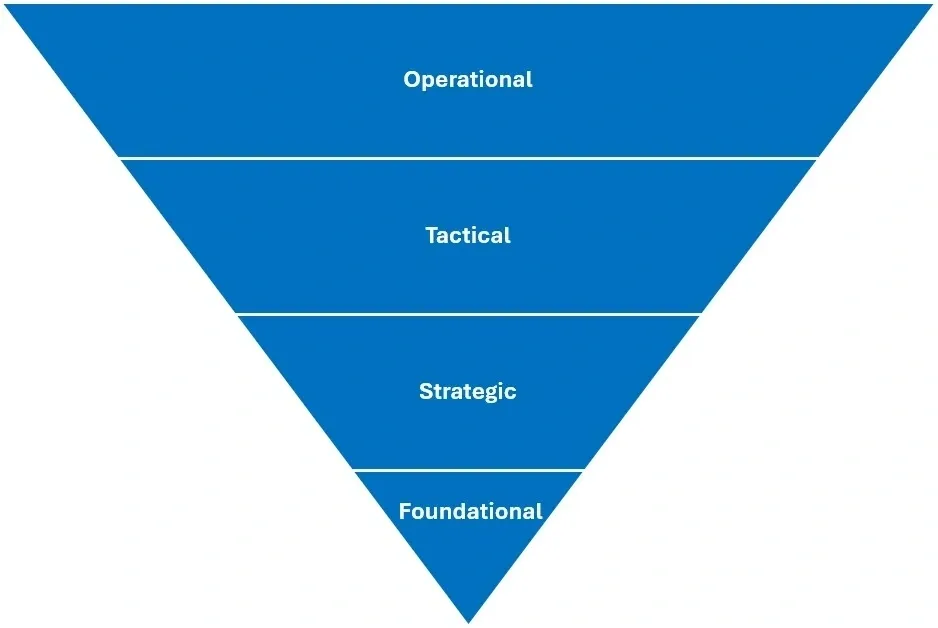
Quick reset: the purpose of the holisticselling framework is to align all organizational functions and processes towards enabling your frontline team members to deliver extraordinary experiences and outcomes to your customers and prospects. In order to achieve success with a holisticselling mindset, we need to ensure that the company is synchronized across 4 different levels (see graphic above):
- Foundational level
- Strategic level
- Tactical level
- Operational level
We are now reviewing the operational level of the holisticselling framework, which consists of 4 components (see the graphic below):
- Lead generation. Lead identification, nurture and conversion.
- Pipeline management. Pipeline growth, maturity, velocity and conversion.
- Sales execution. Opportunity management from engagement to close.
- Account management. Customer management from implementation to advocacy.

We reviewed lead generation last week. Let’s dig into pipeline management this week.
As we all know, a strong pipeline is the best leading indicator of meeting and exceeding your bookings target. Let’s be clear about this: pipeline management must be a core competency of your organization. This only happens when sales, account management and sales operations make it a top priority. I have seen many situations where it does not seem to receive the attention it deserves. This needs to change.
Pipeline management is an area that requires a deep level of analysis, around 4 key dimensions: (a) pipeline growth, (b) pipeline maturity, (c) pipeline conversion and (d) pipeline velocity.
Let’s start with pipeline conversion, which is at the core of determining your pipeline quality. In general terms, pipeline conversion is determined by dividing your bookings from a group of opportunities by the pipeline related to these opportunities. Pipeline conversion needs to be calculated based on a number of parameters, such as:
- Time period (typically quarter and year).
- Sales stage (e.g. stage 1 to stage 5)
- Account type (e.g., customer vs. prospect).
- Opportunity size (e.g. <$100k, $100-250k, $250-500k, $500k-$1M, > $1M).
- Lead type (inbound vs. outbound).
- Opportunity type (e.g. new, cross-sell, upsell, renewal)
- Sales and account management team.
- Individual sales rep and account manager.
- Source (e.g., marketing, sales, partners).
- Industry.
- Account size (e.g. < $250M, $250-500M, $500M-$1B, > $1B).
- Outcome (e.g. closed won, closed lost to competition, closed unqualified, closed no decision).
This requires building a multi-dimensional dashboard that requires a significant amount of analytical capabilities, which many companies do not invest in. This multi-dimensional dashboard should allow you to mix and match any of the parameters mentioned above in order to have a precise indication of your pipeline conversion performance. The more you invest in calculating your pipeline conversion numbers, the more insights you will gain on what is working, what is not working, and what you need to do better.
One area that I found very useful is to measure conversion by sales stage. When you multiply the stage-by-stage conversion rates from stage 1 to ‘closed won’, you will realize that you may only win 5-10% of the stage 1 opportunities. The key is to understand where the performance ‘leaks’ are throughout your sales process. For example, you may realize that your stage 2 to stage 3 conversion is only 40%. You should investigate the root causes of why you are losing 60% of your opportunities at that stage and remedy the underlying problems. This is a great example of how you can convert data to insights and insights to action. Some companies do not capture the data, some do not convert them into insights, and some do not put them into corrective action. Make this happen.
You should also measure your pipeline conversion by outcome. Understanding how much of your pipeline was ‘closed unqualified’, ‘closed no decision’ or ‘closed lost to competition’ will give you insights on how you need to improve your conversion rate.
Remember that pipeline conversion is the ultimate measure of your pipeline quality. A high-quality pipeline will always convert at a higher rate. Invest in a multi-dimensional conversion dashboard. It will pay off.
Let’s move to pipeline growth. First, pipeline volume is a combination of the number of opportunities and the average deal size, so you have 2 levers to consider. The number of opportunities will be determined by how successful your lead generation process is (we discussed this last week). The average deal size will be determined by how successful you are at finding big transformational problems you can help your customers fix, instead of incremental value-adds (which should be aligned with your go-to-market and sales play tactics).
Second, how much pipeline do you need? The simple answer is that, if your annual conversion rate from opportunity creation (stage 1) to closed won is 25%, you would need a pipeline cover of 4x your quota. The key is to be able to calculate your annual conversion rate, which is the wins (in value and volume) from opportunities created in a 12-month period, divided by all the opportunities created in that same period. That requires managing the analysis by cohorts, where you track all the opportunities by time period. Given the fact that enterprise B2B sales cycles can take up to 12 months (and sometimes longer), you may not have a clear indication of the annual conversion rate of that cohort for up to 12 months after the end of that period. For example, if you want to calculate your conversion rate for all opportunities created in 2024, you will need to wait until all these opportunities have been closed (either won or lost), which could take up to 12 months. Despite the lag in calculating the results, I would encourage you to calculate your annual conversion rate for the last 3 years to have an overall indication of your levels, and how they are trending. Complementary to this, you should also calculate your pipeline conversion by quarter, which can be defined as the wins (in value and volume) in a given quarter divided by the pipeline at the start of the quarter. It is preferable to capture the initial pipeline around the 10th day of the first month in order to give your teams some time to clean up their data after the end of the quarter. The quarterly pipeline conversion data are extremely important because they will help you understand execution issues, seasonality trends or market conditions. It is critical to dig into the root causes of poor quarterly conversion numbers and take action to eliminate them.
You need to assess these historical conversion rates by team, depending on your structure (e.g., your prospect team vs. your existing account team). Some teams may show a 30% conversion rate, and others may show a 15% conversion rate. That data will enable you to determine your pipeline targets by team and by individual team member. If possible, I would also recommend calculating conversion rates by team member if you can detect specific patterns (e.g., if a team member consistently converts 30% of her/his pipeline, s/he will need less pipeline cover than another team member who only consistently converts 15% of her/his pipeline). The more accurate your pipeline cover, the better.
Once the pipeline cover targets have been assigned, you can then track the pipeline numbers and compare them to the assigned pipeline cover to see how your teams and individual team members are performing. I would recommend tracking the numbers every month for the last 90 days. That will help you come up with specific corrective action plans for the team members who are lagging behind. Remember that your pipeline should be managed every day of every week. It needs to be a daily habit. Once your pipeline starts running low, you must produce more effort to correct the numbers, and you start making mistakes by accepting opportunities that are not qualified. It is a vicious circle that only a disciplined approach will help you avoid.
Let’s go next to pipeline maturity. The way to assess maturity is to calculate your weighted pipeline by using a sum product of the pipeline at each stage multiplied by the win probability from that stage. The weighted pipeline will give you the most realistic view of how much the pipeline is likely to produce, as long as your stage conversion numbers are realistic. For example, you may currently use the following conversion rates: 1% from stage 1, 10% from stage 2, 25% from stage 3, 40% from stage 4 and 80% from stage 5. You need to make sure these conversion rates map to your actual pipeline performance, otherwise your weighted pipeline will be misleading. Take the time to analyze your pipeline performance over the last 3 years to determine what your actual stage conversion percentages are. Remember again that these numbers may be different by team, by lead source etc., so segment your analysis using your multi-dimensional dashboard to make sure you use the most accurate conversion rates possible. Your weighted pipeline is the best leading indicator of your future performance, so you need to make sure it is as precise as possible.
Let’s close with pipeline velocity. You should be using the same multi-dimensional dashboard you are using for pipeline conversion. Pipeline velocity measures the time from initial opportunity to close, using the same parameters as pipeline conversion. You need to measure it by time period, sales stage, account type, opportunity type, lead source, industry, team, etc.
I would strongly recommend measuring velocity by sales stage. As we know, time kills all deals. You tend to achieve a higher conversion rate when the cycle moves faster. This is especially true early in the sales cycle. For example, every stage 1 opportunity landing in your pipeline should be moved to stage 2 (or moved to closed unqualified) within 30 days at the most – ideally within 7 days. The more time it takes to move an early-stage opportunity forward, the more likely it will end up unqualified.
Another very telling parameter is to measure it by outcome. You may realize that your ‘closed won’ opportunities close a lot faster than your ‘closed no decision’ opportunities. You should analyze why ‘closed won’ opportunities move faster. It will tell you what you did right in these sales cycles.
And here is the kicker: What if you could increase your average deal size by 5%, produce 5% more qualified opportunities, convert them 5% better at every stage, and close them 5% faster? Your productivity would go up 180%! Small incremental improvements, compounded across pipeline growth, conversion and velocity can trigger huge performance increases.
Bottom line, pipeline management is complex and multi-faceted, but it is a critical investment area. You need to build a multi-dimensional dashboard to continuously measure pipeline growth, maturity, conversion and velocity, across a number of key parameters. The more data you capture, the more insights you generate, the more you will be able to take the right actions to ensure that you always maintain the pipeline that you need to meet and exceed your bookings and revenue goals.
Lastly, your sales operations team plays a critical role in managing your multi-dimensional pipeline dashboard and working with the sales and account management teams to review their insights and implement the right corrective actions. Make sure they have the capacity and the skillset to do so.
Message #23
- Make pipeline management a core competency of your organization.
- Invest in your sales operations team to ensure pipeline management is actively measured and managed.
- Build a multi-dimensional dashboard to measure your pipeline performance across a number of parameters (e.g. time period, sales stage, account type, opportunity size, lead type, opportunity type, sales and account management team, individual sales rep and account manager, source, industry, account size, outcome).
- Invest in analytics and AI to uncover the root causes of success and failure. Convert these insights into corrective actions.
- Review your pipeline progress weekly with your sales reps and account managers, monthly with your leadership team and quarterly with all team members. Take corrective action promptly.
Why is this critical to B2B selling? Because your pipeline is the foundation of your B2B sales success.
Questions for you:
- Do you consider pipeline management a core competency of your organization?
- Does your sales operations team have the capacity and skillset to manage your pipeline performance and work with the sales and account management teams to implement adequate corrective actions?
- Do you have a multi-dimensional dashboard that enables you to analyze your pipeline performance across a number of key parameters?
- Are you able to use this dashboard to find the root causes of strong or poor performance? Do you take prompt corrective actions when you find these root causes?
- As a leader, how often do you review the pipeline status with your team members? How often do you review the pipeline results as a leadership team?
That’s it for today. The next newsletter will dive into sales execution. Thanks for reading the holisticselling newsletter and chime in if you have any comments or questions!
This newsletter expands on the operational level of the holisticselling framework and concentrates on pipeline management.
Tags: