The holisticselling Newsletter (#11)
Posted on LinkedIn on August 13, 2025
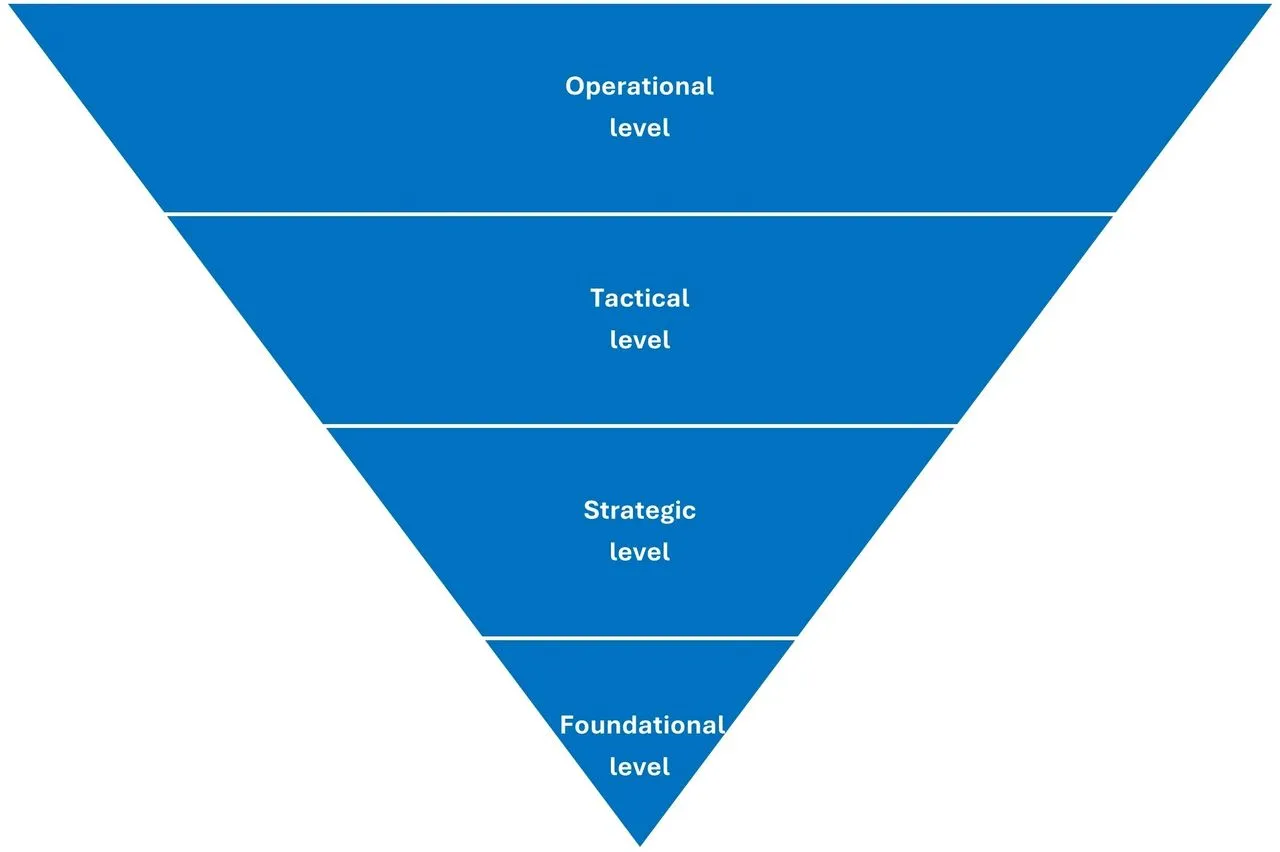
Quick reset for potentially new readers: the purpose of the holisticselling framework is to align all organizational functions and processes towards enabling your frontline team members to deliver extraordinary experiences and outcomes to your customers and prospects. In order to achieve success with a holisticselling mindset, we need to ensure that the company is synchronized across 4 different levels (see graphic above):
- Foundational level
- Strategic level
- Tactical level
- Operational level
The last 5 newsletters have been dedicated to the tactics and capabilities needed to enable the holisticselling framework across 5 key areas: 1. go-to-market, 2. sales enablement, 3. marketing, 4. sales/business development and 5. solution consulting and value engineering.
Today, we will focus on one area that has probably been the most difficult to deploy successfully: partner management. Effective partner management is essential to grow and win in the B2B software world, but it often delivers suboptimal results.
Let’s first define what we mean by partner management. A comprehensive partner management program should include multiple types of partners:
- Services partners. These are specialized partners providing implementation, integration, consulting, and support services (commonly called system integrators, or SIs).
- Technology partners. These are companies in the same space with complementary offerings. These partnerships can be structured as an imbedded technology agreement (the partner solution is fully integrated into your solution), a reseller agreement (the partner product is resold by your company) or co-sell agreement (both companies collaborate to sell their complementary products to a shared customer base).
- Marketing partners. These are marketing agencies or media companies that you partner with to co-brand content, launch joint campaigns or schedule webinars to reach wider audiences and amplify your brand presence.
- Consultants and advisory partners. These could be individuals or companies that provide expertise and guidance to your business and help clients choose and implement software solutions. Their role is to represent your brand and differentiate your offerings by acting as trusted advisors with your customers and prospects. This has become a more important partnership area with the ubiquitous role of social media, which is often under-utilized by B2B software companies.
You can engage partners across a number of joint activities, such as development, marketing, lead generation, sales, implementation and customer success. The benefits of a successful partner management program have been well documented:
- Faster sales cycles,
- Increased win rates,
- Reduced customer acquisition costs,
- Expanded market reach,
- Increased brand awareness,
- Sharing of resources and expertise,
- … and ultimately higher revenue.
With so many benefits, why has partner management been so difficult to implement successfully? Here is a list of issues I have witnessed in my 25 years of industry experience:
- Lack of strategic alignment. Both your company and the partner must share a common purpose, similar values and a joint targeted customer base for the relationship to work. Goals have to be aligned. For example, if your service partner wants to generate $10M of revenue to invest in the relationship, but you can realistically only generate $5M, you are barking up the wrong tree. Or if your technology partner has expectations of winning 10 deals with you in the next 6 months but your pipeline does not support it, the relationship will go south. I have seen a lot of wishful thinking in this area.
- Under-resourced partner management programs and teams. No software company can succeed without a vibrant partner management program, but these programs tend to be run by skeleton teams with limited resources. Adding to the confusion is the fact that the different types of partners tend to be managed by different functions (e.g., service partners by Alliances, technology partners by Product Management and marketing partners by Marketing).
- Poor onboarding, training and certification programs. Partners cannot effectively extend your brand in front of customers unless they are properly trained and certified. I have seen organizations with a commitment to developing their partner ecosystems, and at the same time fail to invest in a first-class onboarding, training and certification program. You need to walk the talk and build a team dedicated to this key capability.
- ‘Going through the motions’. Too many times, the partner management team goes through the motions with the sales and account management teams, repeating a process of internal and external cadence calls without noticeable progress. That needs to be addressed through a much more rigorous inspection of results against the right KPIs, such as partner-sourced or partner-influenced revenue. If your goals are not attained, action needs to be taken to remedy the problem. Kicking the can down the road instills a culture of mediocrity that will kill the program.
- Conflicts of interest. Navigating a process where both companies are also engaged with each other’s competitors is not easy. For example, the software company can have multiple service partners, and the service partner can engage with competing software companies. Finding a ‘safe zone’ is key to an open dialogue.
- Lack of mutual trust. Very often it seems like a meeting between ‘partners’ is a carefully choreographed dance in which neither party wants to take the first step. For example, when it comes down to selecting joint target accounts, both parties count on the other one to go first. This is caused by a lack of trust, not only between each other, but also in the overall outcome of the process. Trust is gained through joint success stories, but joint success stories do not happen without trust. This is a vicious cycle, often reinforced by the conflicts of interest mentioned above.
- Unproductive engagement process. I think every form of engagement has been attempted over time, from top-down strategic alignment sessions to bottom-up targeted account management sessions. I have witnessed countless top-down executive sessions that never produced a successful outcome for either party. At the end of the day, success or failure is determined at the coal face, so partner engagement at the account level is critical.
- Long road to success. Engaging on a joint account list, winning a joint deal and successfully implementing a joint account takes a long time. It is difficult to keep the relationship going when success does not happen quickly, especially if both parties made investments that did not pay off.
So, with all these obstacles in the way, what can you do to improve the success of your partner program? Here are a few best practices I would recommend considering:
- Invest in your partner program. Your partner ecosystem is critical to your success, so do it right. Invest in a first-class partner onboarding, training and certification program. Wow your partners with the quality of your enablement process and the investment in their success.
- Find the right partners. The partner and you should share the same cultural values and offer complementary capabilities. Most importantly, both partners should have clear and realistic expectations of what the partnership will produce. Time and time again, I have seen small or midsize software organizations try to partner with large partners – to no avail. If both parties cannot agree on the KPIs upfront, walk away – you are wasting your time.
- Have clear goals – and enforce them. Each partner relationship needs to be based on a specific set of goals, such as deal volume, bookings value etc. Measure progress on a periodic basis. If, after taking all the right steps, a partner relationship does not produce results, have the courage and conviction to walk away. I have seen too many unsuccessful partnerships that never end, hoping that things will get better later. This is totally unproductive.
- Align at the sales playbook level. Both partners need to share the same sales plays and be clear on their respective roles and responsibilities to leverage the sales playbook successfully.
- Invest in each other. Build joint sales playbooks, produce joint marketing materials, invest in joint marketing campaigns, etc. The partnership needs to be seen by the customers and prospects as a serious and committed endeavor, otherwise they may not trust that it will deliver value to them.
- Establish open and direct communication. As mentioned above, mutual trust is critical for success. Trust needs to exist at every level, starting from the top. Establishing executive sponsorship is an important step to forge a common purpose and address any disconnect.
- Engage at the account level. You need to ensure that your sales reps and account managers engage with their counterparts pursuing the same account. Nothing will happen until the human connection has been successfully established at the account level. This is ground zero to build the trust needed to win deals together and deliver customer success together.
- Prevent channel conflicts. Implement measures such as clear engagement terms, territory maps, account lists, lead registration systems etc. to minimize competition among partners. When and where you decide to partner, be exclusive to each other. I have seen situations where partners engage multiple software providers on a single opportunity, and that never works out.
- Be decisive and win fast. Every successful relationship is built on positive reinforcement. Build every program on a 90-day timeframe. Show forward progress every 90 days. Clear obstacles and win fast. A joint successful win will be the best medicine for your partnership!
Finally, as we discussed previously, partner management is also an area that will be impacted by AI. Certified partners should have access to the same AI capabilities as your team does. They should be able to leverage your company-proprietary AI LLM to personalize, for example, their onboarding program, their training curriculum and their messaging recommendations. These capabilities should be delivered to them via AI-powered chatbots and personal assistants that can give them instant answers to common partner queries, offer real-time support, and guide them through processes like deal registration and incentive programs. This will reduce the burden on your partner support team and improve partner satisfaction.
Message #21
- Invest in your partner program as if your future depends on it – because it does.
- Wow your partners with a best-in-class onboarding, training and certification process.
- Select your partners based on realistic qualification criteria – not what you would like to achieve in 5 years, but you can achieve in the next 12 months.
- Create trust by agreeing on goals and expectations, establishing direct and open communication and eliminating frictions and conflicts of interest.
- Share your AI LLM contents with your certified partners to ensure alignment with your go-to-market strategy.
- Build the program for speed – all successful partnerships start with one customer success story!
Why is this critical to B2B selling? Because a vibrant partner ecosystem is essential to the success of your company as well as the success of your customers.
Questions for you:
- How successful is your partner program across all partner categories (services, technology, marketing and advisory)?
- How are your partner categories managed today? Are they managed together by one team, or by separate teams? If so, how do you ensure consistency in partner onboarding, training and certification?
- How do you select your partners? What criteria and qualifications do you use to ensure you select the right ones?
- How formalized is your partner onboarding, training and certification program?
- How do you build trust with your partners?
- How do you prevent channel conflicts with your partners?
- Are your partner programs tied to clear goals and expectations? Are you measuring your joint progress against these goals? Are you actively making continuous improvements if they are not successful yet? Are you willing to walk away if they do not deliver the right results?
- Are you sharing your AI LLM contents with your certified partners?
One final word on the tactical level of the holisticselling framework. There are other functions involved in enabling your frontline team members to deliver extraordinary experiences and outcomes to your customers and prospects. I will put them in 3 groups:
- Sales Operations and Revenue Operations.
- Finance and Legal.
- Professional Services, Support and Customer Success Management.
For the sake of moving forward to the operational level of the holisticselling framework, I will not discuss these functions in detail at this time. We could certainly revisit this at a later stage.
Next up: the operational level of the holisticselling framework. See you next week! And as always, feel free to share your thoughts on the contents of this newsletter.
Tags: