
The HolisticSelling Newsletter (#10)
Posted on LinkedIn on August 6, 2025
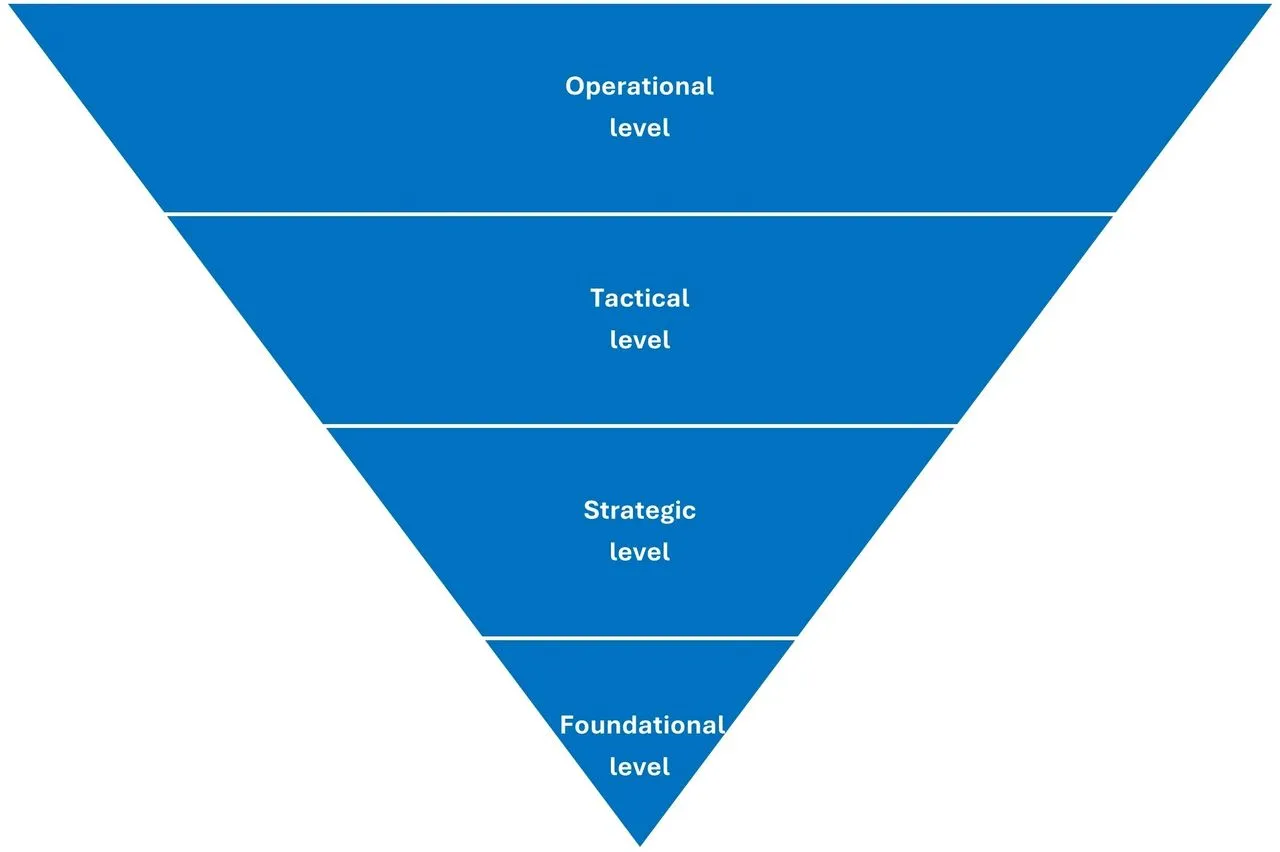
As we know by now, the purpose of the HolisticSelling framework is to align all organizational processes and functions towards supporting your frontline team members to deliver extraordinary experiences and outcomes to your customers and prospects. In order to achieve success with a HolisticSelling mindset, we need to ensure that the company is synchronized across 4 different levels (see graphic above):
- Foundational level
- Strategic level
- Tactical level
- Operational level
This week, we will continue to review the tactical capabilities enabling the HolisticSelling framework. As we discussed last week, the sales reps and account managers need to tightly collaborate with the SDRs and BDRs throughout the lead generation process. When the leads turn into opportunities, the solution consultants and value engineers become their best friends, so let’s focus today on 2 key areas that are tightly connected: solution consulting and value engineering.
Let’s start with solution consulting (aka sales consulting or sales engineering). The solution consultants (SCs) play a critical role in the sales cycle, especially in the early stages. From a tactical capability standpoint, I have listed below the 5 best practices I would recommend deploying. Some of this may sound evident, but I have seen many situations where these simple principles were not applied, leading to dysfunction and loss of winnable opportunities.
First, treat the solution consulting team as a peer to the sales and account management teams. Sales reps and account managers would not be able to win deals without a deep partnership with the SCs. Invite your solution consulting team to your sales kickoff meetings, quarterly business reviews and sales team calls to ensure 100% alignment. Ensure the SC compensation plans are aligned with the sales reps and account managers compensation plans. We all win together.
Second, ensure that the SCs are highly trained in the following areas:
- Domain expertise. Remember that it is always about the customer, not about you. A deep understanding of the customer business is important to connect with your audience. Ensure that you build that level of expertise in every industry you sell into. Cross-train to maximize resource allocation flexibility.
- Sales play process. Follow the sales play methodology by focusing first on the problem, not the solution. Customers do not care about your products, they care about finding a solution to a problem. Make sure your SCs position business outcomes, not product features.
- Solution expertise. When the problem scope has been validated and the challenges and pain points identified, your solution consultants will need to deliver the solution pitch. They will need a strong command of both the solution capabilities and the proof points to convince the customers to move forward with you. As with domain expertise, cross-train to maximize resource allocation flexibility.
- Communication style. The most important ingredient to win deals is trust. You earn trust by demonstrating that you deeply care about the customer and that you have the expertise to address their challenges. Practice active listening skills, connect with your audience and always demonstrate empathy and humility.
Third, ensure clarity about the roles and responsibilities of the SCs, as listed below:
- RFx responses. No one in the B2B software world likes RFXs, but more and more organizations turn to formal buying processes. The SCs play an important role in assessing and qualifying RFxs to ensure the company has a shot at winning the deal.
- Discovery. The SCs need to be brought in to validate the problem the customer wants to solve. You need to make sure you address the root cause of the problem, not the symptoms. I have seen many situations where sales reps jump on a symptom to qualify an opportunity and discover later that they were going after the wrong problem. Go slow to go fast. Uncovering the root cause of a problem may take more time early, but it will pay dividends later. Always focus on the diagnostic before offering a prescription!
- Qualification. Once you and the customer have agreed on the root cause of the problem, then the SCs need to qualify the opportunity across 3 filters: fit, competitiveness and affordability. Do you have the right solution? Can you win against the competitors engaged in the customer evaluation process? Does your solution fit the customer’s budget? I recognize that it is not always easy to get the right answer to these questions early in a sales cycle, but the sooner you can assess your position on all 3, the better. Fail early/fail fast if the opportunity does not look right. Some sales reps may tend to pursue all opportunities in order to boost the pipeline, but you need to have the intellectual fortitude to walk away if the opportunity is not qualified.
- Solutioning. Based on the customer information gathered through the RFx and/or discovery process, the SC team needs to come up with the solution that will be most suited to solve the problem for the customer. This needs to be documented in the form of a ‘solution blueprint’ or similar work product. The solution blueprint needs to include not only the company’s products but also the points of connection and integration with any 3rd party products included in the solution definition. This solution blueprint needs to be shared with the customer to ensure alignment with their expectations.
- Demonstration. After responding to a RFx and finalizing discovery, qualification and solutioning, you will most likely be asked to demo your solution. This may sound trivial, but there again I have seen many issues with the demo process. First of all, some sales reps tend to book demos with customers without having gone through proper discovery, qualification and solutioning. This is a recipe for disaster. Second, demos are sometimes booked without a clear solution blueprint agreed upon with the customer, leading to the proverbial ‘throwing stuff on the wall to see what sticks’. Third, even when proper discovery, qualification and solutioning has taken place, the team may not take enough time to dry run the demo presentation, leading to a suboptimal outcome. Finally, every demo needs to be focused on positioning business outcomes, not product features. You need to show the customer how you will deliver the right outcomes in a way that differentiates you from your competitors.
- Follow-up. While in theory the customer should finalize its decision after the demo presentation round, very often, additional questions and requests surface, which require the attention of the SC team.
Fourth, invest in a strong demo engineering team to maintain updated demo environments by region and industry. Ideally, you should have a version of the demo environment that is tailored for each region and each industry you are selling to. The demo engineering team should also prebuild a use case library that maps to your sales plays. That would minimize the amount of work the field SCs have to do to build their demos for each customer.
Fifth, ensure that you have the right number of SCs to handle the number of sales cycles required to meet your SaaS bookings goal. The recommended ratio of reps to SCs in enterprise SaaS is 2:1 to 3:1. So, following up on the example we used last week, if you have a $20M SaaS bookings plan with average quotas of $1M per sales rep and an average productivity of 65%, you will need 31 reps ($20M / $1M / 65%) to deliver $20M – which means you will need between 10 and 15 SCs. That number may of course vary depending on a number of factors, such as the market you are going after (enterprise vs. mid-market), the deal complexity, the product breadth and the sales cycle length. Selling complex deals into a highly strategic market may require a 1:1 to 2:1 ratio, while selling simpler low touch deals into the mid-market may only require a 4:1 to 5:1 ratio.
Instead of relying on industry averages, you can also calculate the number of SC hours needed to support your sales goal. Let’s illustrate this with an example. If each rep has a $1M quota with an average productivity of 65%, the average achievement per rep will be $650,000. If the average deal size is $100,000, that means closing 6.5 deals per year.
How many SCs will you need to support that number? It will depend on the number of opportunities in the pipeline and the number of SC hours needed for each opportunity. If we follow a traditional 5-stage sales process, you may estimate that, for example, it will take an average of 5 hours of SC time in stage 1 (see the table below). Based on the assumed stage-by-stage conversion rate, closing 6.5 deals would require qualifying 43.4 opportunities in stage 1, which would then require a total of 217 hours of SC time (5 hours x 43.4 opportunities). If you follow the same logic for the other stages, you end up with a total of 527 hours of SC time per rep. Assuming that each SC works 1,800 hours per year with a 70% productivity (time directly spent on opportunities), you end up with a rep/SC ratio of 2.4. So, to deliver $20M in SaaS bookings, you will need 31 reps and 13 SCs (31 / 2.4).

Feel free to change these assumptions as you see fit and let me know if this simple model is helpful. I would recommend that you follow some sort of resource model to ensure you have enough SC resources to support your goal. It will also help you justify your resource requirements with Finance.
Lastly, your AI strategy will also impact the performance of your SC team. As we mentioned in the previous newsletters, once all your internal and external contents have been uploaded into your company-proprietary AI LLM, your SC team should be able to use your AI tool of choice to, for example, generate the discovery questions and demo scripts tailored to each specific opportunity. This will save a lot of time and lead to a more optimized outcome.
Message #19
- Leverage your demo engineering team to pre-build the demo instances and use cases needed to accelerate and simplify the work of your field SCs.
- Treat your SC team as a peer to your sales and account management teams.
- Ensure that your SC team has the skills and qualifications to successfully connect with your customers and prospects.
- Ensure that your SC team is appropriately staffed to handle their responsibilities at the speed of business.
Why is this critical to B2B selling? Because your solution consulting team is at the center of assessing, qualifying and winning every opportunity.
Questions for you:
- Is your SC team invited to your sales kickoff, quarterly business reviews, deal review calls and forecast calls?
- Is your SC team headcount in line with the 2:1 to 3:1 ratio of sales reps to SCs? Have you built a specific resource model for your company that validates that headcount allocation?
- Are your SCs engaged early in the opportunities to validate the problem, qualify the opportunity and design the right solution?
- Do you have a process in place to ensure that the right amount of discovery and preparation takes place before each demo presentation?
- Do you have a demo engineering team in place to prebuild the demo instances and use cases to be leveraged by the field SCs?
- Are you leveraging your company-proprietary AI LLM to help your SCs accelerate and optimize the discovery, qualification and demo process?
Let’s also cover value engineering (VE), which as a function, is typically aligned with solution consulting. Every B2B software company has a ‘value selling’ message, yet many fail to back it up with the appropriate tactics and capabilities. See below 3 best practices I would recommend deploying to align with the HolisticSelling framework.
First, ensure that the VE team is competent to successfully manage the following responsibilities:
- Business case development. Can they quantify and defend ROI/TCO in CFO-level terms?
- Industry insights. Do they understand industry-specific challenges and pain points?
- Financial acumen. Are they comfortable with financial metrics such as NPV, IRR and payback modeling?
- Customer engagement. Do they work consultatively with customers and prospects to adapt their approach to each company (as needed)?
- Internal enablement. Do they coach SCs, sales reps and account managers on value conversations? Are they collaborating on all relevant opportunities?
- Post-sale value realization. Are they engaged with customers to track and prove value after implementation?
Second, put in place the right tools and processes to ensure the success of your VE team.
- Value calculator. Does your VE team have a value calculator tool adapted to the products you sell and the industries you sell to? Is this tool flexible enough to adapt to the customers’ specific value methodologies?
- Alignment with your go-to-market strategy. Is your value methodology aligned with your sales plays? Have you prebuilt value hypotheses that support each one of your sales plays?
- Value messaging. Do you have a set of value data you collected from your customers to use them as proof points for your business cases?
- Internal engagement. Is your VE team deployed on all opportunities that meet specific criteria (e.g., opportunities > $250k, need to get CFO endorsement, strong competition)?
- Post-sale value realization. Is your VE team engaged with your customers to measure the value realized after implementation?
Third, ensure that the size of your VE team is sufficient to handle the value-selling workload across your sales and account management teams. The VE function is often under-resourced. This is why the HolisticSelling alignment across the strategic, tactical and operational level is so important. Many companies claim to have a ‘value selling’ strategy but do not support it with the right tactical capabilities, which impacts execution at the operational level. The rule of thumb for strategic enterprise B2B sales is to implement a ratio of 5:1 to 10:1 sales reps and account managers to VE consultants. So, if you have 31 sales reps/account managers, you should have 3 to 6 VE consultants. Remember that these consultants need to support both the value estimation process pre-sale and the value realization process post-sale. Having the ability to measure realized value after implementation is immensely valuable to acquire hard success metrics and build customer advocacy.
Finally, let’s not forget the impact AI will also have on your VE practice. On top of all other internal and external contents we have already discussed, you should load all your business cases and value realization studies into your company-proprietary AI LLM and leverage your AI tool of choice to generate your business cases. That will significantly improve the speed, flexibility and accuracy of your numbers.
Message #20
- Imbed your VE team into your SC team to ensure alignment.
- Ensure that your VE team has all the required qualifications to build ‘trust in numbers’ with your customers and prospects.
- Ensure that your VE team is staffed to handle value selling pre-sale as well as value realization post-sale.
- Put in place a process that ensures the engagement of your VE team on all qualified opportunities (it will not happen consistently unless you do!).
- Engage your VE team with selected customers to calculate value realization (you need these numbers as proof points!).
Why is this critical to B2B selling? Because value selling is critical to demonstrate to your customers and prospects that your solution will deliver the right business outcomes.
Questions for you:
- Do you have a value engineering team in place? Is it big enough to support your value selling process across all qualified opportunities?
- Do you have a process in place to enforce the engagement of your VE team in all qualified opportunities?
- Is your value calculator homegrown or 3rd party? Is it adapted to the specific products you sell into your target industries? Is it flexible to adapt to the customers’ value methodologies?
- Is your VE team involved in measuring value realization after implementation for the subset of your customers that fit your sales plays?
- Are you leveraging your company-proprietary AI LLM to help your VE consultants accelerate and optimize the value selling and value realization process?
That’s it for this week. Next week, we will close off the review of the tactical level of the HolisticSelling framework and then proceed with a deep dive into the operational level. As you can tell, your success in B2B selling depends on the synchronization of all your processes and functions across the foundational, strategic, tactical and operational level. Thanks for your continuous support of the holisticselling newsletter!
Tags: