
The HolisticSelling Newsletter (#9)
Posted on LinkedIn on July 30, 2025
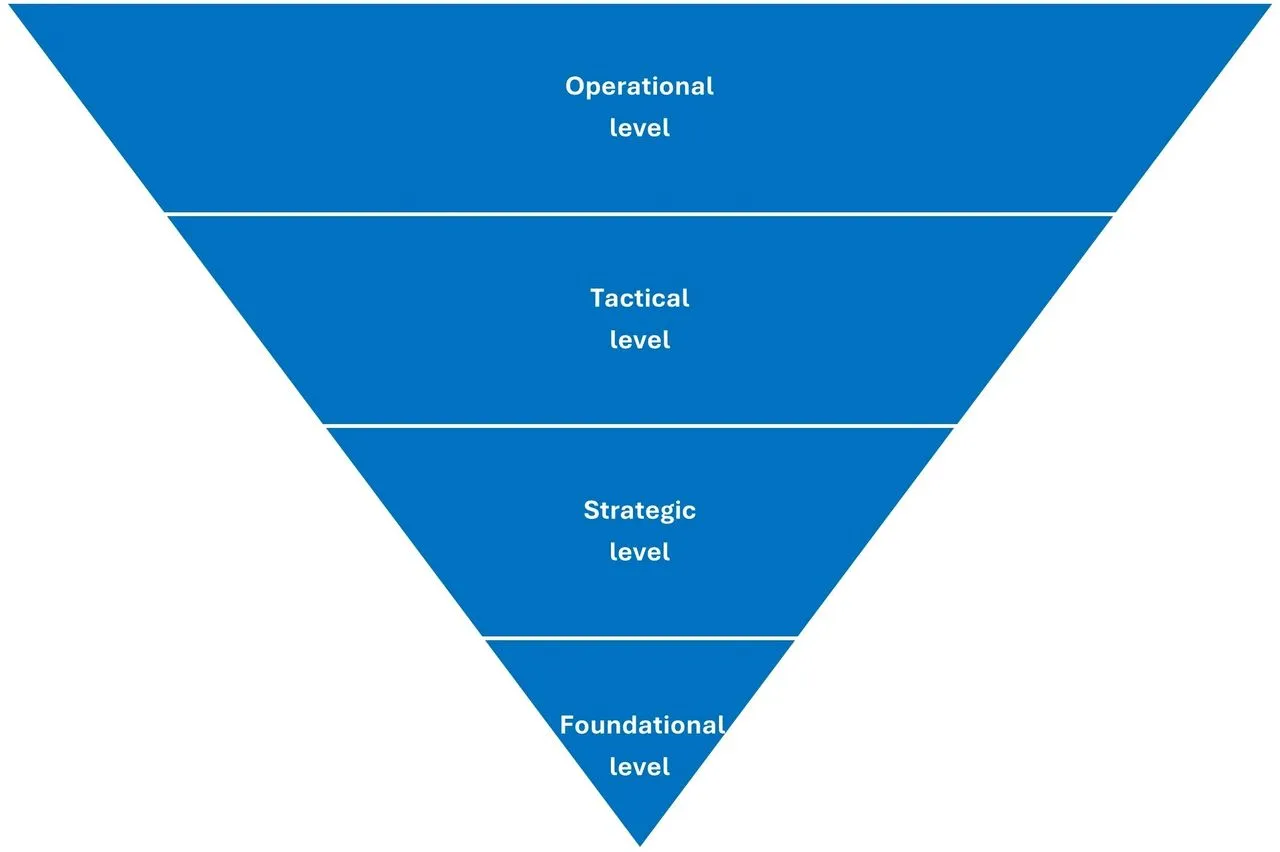
You know the drill by now: the purpose of the HolisticSelling framework is to align all organizational processes and functions towards supporting your frontline team members to deliver extraordinary experiences and outcomes to customers and prospects. In order to achieve success with a HolisticSelling mindset, we need to ensure that the company is synchronized across 4 different levels (see diagram above):
- Foundational level
- Strategic level
- Tactical level
- Operational level
In the last 3 weeks, we covered the go-to-market (GTM), sales enablement and marketing tactics. Today, we will concentrate on the sales/business development function.
This function plays a critical role in finding, nurturing and qualifying leads. It is at the core of building a high-quality pipeline that enables you to meet your SaaS bookings goals. Despite its importance, this function is often not getting the full attention it deserves. That needs to change. Finding, nurturing and qualifying leads in today’s age of oversaturation and commoditization requires a high degree of specialization and differentiation. That degree of specialization is the reason why it is less and less likely that sales reps themselves (especially on the net new side of the house) will be able to generate their own pipeline. We will elaborate on this further when we review the operational level of the HolisticSelling framework.
Whether the job is to manage inbound or outbound leads, the dialogue you need to have with your customers and prospects must be surgically mapped to the stage in their buying process. It has been well documented that customers and prospects nowadays manage the first 70% of their buying process on their own before contacting their potential vendors. That first 70% of their journey is referred to as the ‘dark funnel’.

Not only do you need to identify which customers and prospects (at the persona level) are in the ‘dark funnel’, you also need to understand which stage they are in. Have they clearly identified the problem they need to address yet? Have they already converted it to a clear need description? Have they started exploring solutions and identifying their solution requirements? Have they completed their vendor search to determine which vendors they would want to engage with? Every stage requires a different approach and communication content.
This is why the sales/business development function needs to be considered as a strategic investment, specifically in 2 areas: talent and technology. First, talent. It has been common practice to hire ‘junior’ team members in the sales/business development function. I believe this is a miss. I have experienced situations where SDR/BDR positions are ‘entry-level’ positions that rotate every 12-18 months and where SDR/BDR positions are filled by experienced/highly qualified ‘inside sales’ team members committed to staying in their position for a longer period of time, and the latter has proven to generate better results. Second, technology. This is an area where AI will have a massive impact. There is a large number of ‘traditional’ tools that the sales/business development team can use to find, nurture and qualify leads, such as 6sense, Outreach and ZoomInfo, but the future belongs to companies that will comingle these outside data sources with their internal go-to-market, sales enablement and marketing content into their company-proprietary AI LLM in order to enable their sales/business development team, in collaboration with marketing and sales, to find the best ‘suspects’, engage with them using the content most appropriate for the buying stage they are in, nurture them through the process and deliver highly qualified leads to the sales and account management teams.
We need to understand that the sales/business development team members have a vital job to do. They often are the first point of contact with a prospect. Impressions are formed based on these initial touchpoints. That is why you need to consider significantly upgrading your talent and enabling that talent with the best available technology investments to achieve success.
Also remember that your target personas are overloaded with vendor communications. How do you get through that clutter? You need to ensure that all your touchpoints are focused on them (not you) – so, lead with business outcomes and proof points, do not lead with products and capabilities. And do so with empathy, humility and expertise. Your job is to serve your customers and prospects and help them find solutions to their problems – right from the very first touchpoint.
Let’s also clarify the SDR (Sales Development Representatives) and BDR (Business Development Representatives) terms. A commonly acceptable notion is that SDRs handle inbound leads and BDRs focus on outbound prospecting. In enterprise SaaS, it is generally not optimal for the same person to handle both inbound and outbound leads. SDRs qualify and convert marketing-generated leads and BDRs proactively target named accounts with tailored outreach.
That distinction allows you to break down the types of leads into 4 buckets (see diagram below):
- Inbound leads from customers.
- Outbound leads from customers.
- Inbound leads from prospects.
- Outbound leads from prospects.
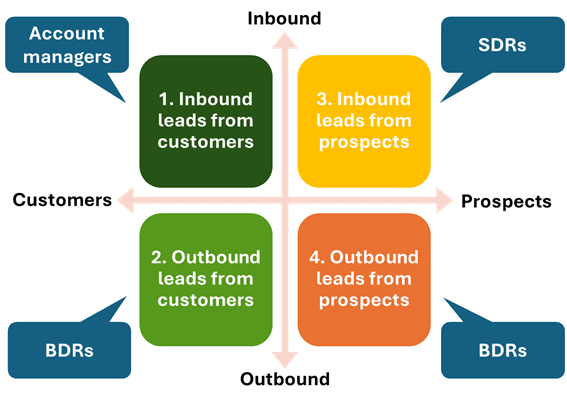
This categorization is important because it has an impact on your organizational capabilities. The way you manage leads will differ by type. Inbound leads from customers should be passed on directly to the account managers (no need to introduce an SDR into an established relationship). Inbound leads from prospects need to be nurtured and qualified by the SDR team. Outbound leads (for both customers and prospects) should be managed by the BDR team.
How many SDR/BDR positions do you need? The ratio of sales reps/account managers to BDR/SDR positions is typically 2:1 to 3:1. That number may of course vary based on your company size and maturity, the market you are selling into (enterprise vs. SMB) and the type of solutions you are selling (high cost/complexity and low volume vs low cost/complexity and high volume).
Let’s use an example. Let’s say your annual SaaS bookings plan is $20M. If your average rep quota is $1M and your average rep productivity is 65%, you will need 31 sales reps/account managers ($20M / $1M / 65%). At a high level, that means that you will need between 10 and 15 BDR/SDR positions.
If you want to come up with a more precise resource allocation, we can use a simple model to break down your SaaS bookings plan by type of account and by type of opportunity. See below:
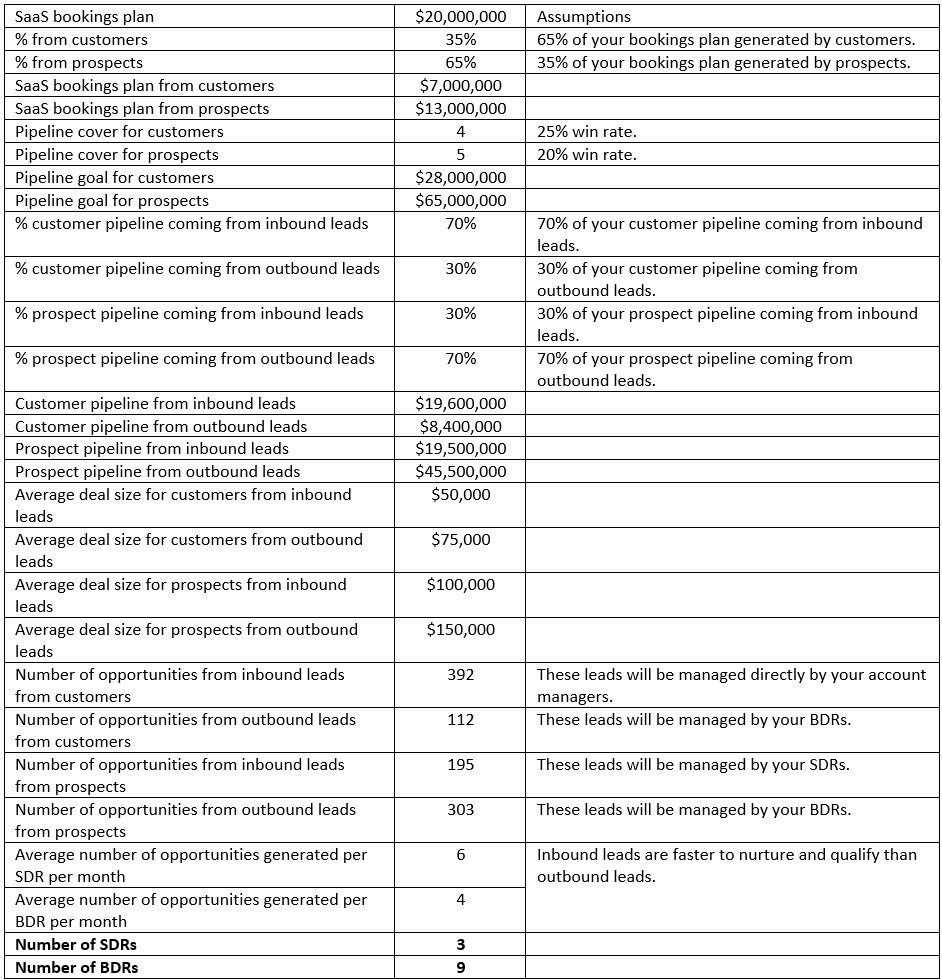
Using these assumptions, you would need 3 SDRs and 9 BDRs. Feel free to plug in your own assumptions to make sure you have the adequate number of BDRs and SDRs to meet and exceed your SaaS bookings plan.
Finally, which function should the BDR/SDR team report to? Sales or Marketing? I would recommend having it report to Sales due to the high level of required coordination between BDRs/SDRs and sales reps/account managers (which we will discuss when we cover the operational level of the HolisticSelling framework).
Message #18
- Treat the sales/business development function as a strategic investment.
- Optimize your SDR/BDR resource allocation to ensure you generate the right pipeline to help your frontline sales and account management teams achieve their SaaS bookings plan.
- Consider upgrading your SDR/BDR talent from entry-level positions to proven inside sales team members.
- Invest in building your company-proprietary AI LLM by aggregating external data sources (such as 6sense and ZoomInfo) with your go-to-market, sales enablement and marketing content in order to enable your SDRs and BDRs to engineer specific touchpoints that are relevant for each stages in the buying journey.
Why is this critical to B2B selling? Because the sales/business development function is highly critical to generate the qualified pipeline you need to achieve your SaaS bookings plan.
Questions for you:
- How strategic is your investment in the sales/business development function?
- Does your sales/business development team consist of ‘entry-level’ team members rotating every 12-18 months or proven/qualified inside sales team members committed to staying in the job for a longer period of time?
- Are you committed to building your company-proprietary AI LLM and enable your SDRs and BDRs to leverage it to find, nurture and qualify leads?
- Do you have the right number of SDRs and BDRs to generate the pipeline required to support your SaaS bookings plan?
- How is your sales/business development team organized? Do you have both SDRs and BDRs? How are they allocated to support your account managers (current customers) and account executives (prospects/new customers)?
- Which function does your sales/business development function report to: sales or marketing (hint: your bias should always be to align with the frontline sales and account management teams to eliminate potential functional frictions)?
Next week, we will continue to dive into the tactics and capabilities of the other functions that support the success of your frontline customer-facing team members. We still have a few to cover before we move to the operational level of the HolisticSelling framework.
Feel free to let me know your thoughts on the contents of the newsletter. My goal is to share insights that may help you optimize the performance of your teams!
Tags: