The holisticselling Newsletter (#7)
Posted on LinkedIn on July 16, 2025
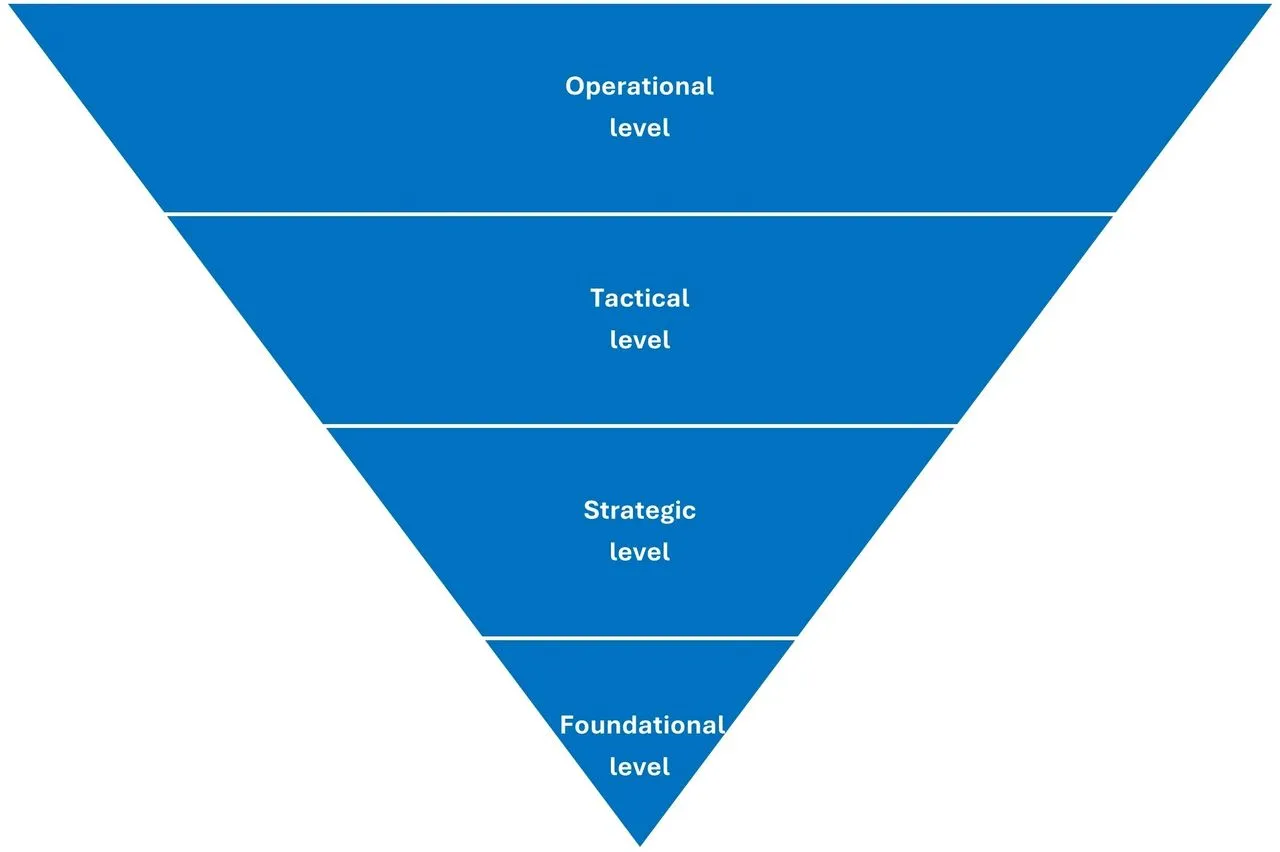
You know the holisticselling premise by now: you need to ensure that all your company functions and processes are synchronized to deliver extraordinary experiences and outcomes to your customers and prospects. That synchronization needs to happen at 4 levels (see diagram above):
- Foundational level
- Strategic level
- Tactical level
- Operational level
We are now looking at the tactical level. In last week’s post, we discussed the go-to-market (GTM) tactics required to implement the holisticselling framework. This week, we will focus on sales enablement.
The founding principle of the holisticselling framework is to help customers achieve their business outcomes (outside-in perspective), yet many sales enablement programs in the B2B software industry are built around training the customer-facing team members on the company’s products and capabilities (inside-out perspective). This approach has been very sticky for many years. Sales enablement needs to be re-architected 180 degrees to make the customer outcomes the center of what the customer-facing teams get trained on. The purpose of sales enablement, in the holisticselling world, is to empower your customer-facing team members to have conversations that focus on delivering extraordinary experiences and outcomes to customers and prospects. I cannot overstate how critical this is. The more you understand the world your customers and prospects live in, the more you will be able to help them achieve their business outcomes. Remember that customers don’t buy products or capabilities, they buy solutions to their problems to help them achieve their goals.
What is the correct approach? First, you need to build your GTM sales plays, as we discussed last week. Your sales plays define the blueprint for all the conversations with your customers and prospects. You then need to build your sales enablement contents on top of your sales plays. That will include building training materials on:
- The industry segments you are going after. Every customer-facing team member needs to have a strong understanding of the industries they are covering. The deeper their expertise is, the better their ability to offer the right advice to your customers and prospects. This will help you create a differentiated level of trust that will propel your growth.
- The personas you are targeting within these industry segments. Their typical goals, strategies, challenges and pain points.
- The 2-minute elevator pitch for all the solutions included in your sales plays.
- The 20-minute presentation of the capabilities supporting the elevator pitches.
- And most importantly, the value statements and customer case studies that prove your solutions can help the personas achieve their business outcomes.
Once these sales enablement materials are built, the traditional approach has been to encapsulate them into training courses, assemble these courses into curriculums and certify your customer-facing team members on their specific role-based curriculum, potentially adding live role-play activities to reinforce the learning process.
It is fair to say that this approach has traditionally fallen short. It is valuable as part of an onboarding and ramp process, but it is not sticky enough over time if not practiced on an ongoing basis.
This is why AI will have a profound impact on sales enablement. The next step should be to load all your sales enablement materials into your company-proprietary AI LLM. Then, instead of having to labor through training curriculums time and time again, the customer-facing team members will be able to interrogate the company-proprietary LLM through your AI tool of choice to find answers to all their questions – on demand, every day, one interaction at a time.
Let me use one example to illustrate this. You have a call scheduled tomorrow with a CFO in an electronic components company (one of your target industry segments). You can interrogate the AI LLM to understand (a) which business outcomes, challenges and pain points a CFO in that industry sector and in that specific company will want to discuss, (b) which solutions your company offers that will help that CFO achieve her/his goals and (c) which proof points you have available to convince her/him to engage with you. More advanced AI LLM methodologies (such as the one developed by Pangea Summit ) also enable you to build a personality profile for that specific CFO so you can focus on her/his specific goals and use the appropriate conversation style and tone to capture her/his attention. This is really groundbreaking!
Bottomline, the world of sales enablement needs to be transformed in 2 ways:
- Content production. Your sales enablement contents need to be built on top of your sales plays and re-engineered around an outside-in perspective.
- Content publication. Your contents need to be loaded into your company-proprietary AI LLM to enable all customer-facing team members to question it and obtain the exact information they need to fuel every interaction with every persona they are targeting – on demand, in real time.
Message #16
- Build your GTM sales plays first. That is the blueprint for what you need to train your customer-facing team members on.
- Build the sales enablement materials needed to train the customer-facing team members on all aspects of your sales plays (industry segments, personas, business outcomes, challenges/pain points, solution elevator pitches and capabilities – and most importantly proof points).
- Encapsulate your sales enablement materials into training courses, assemble these courses into curriculums and certify your customer-facing team members on their specific curriculum, based on their role, potentially adding live role-play activities to reinforce the learning process.
- Load your sales enablement materials into your company-proprietary AI LLM.
- Leverage your AI tools on top of your company-proprietary AI LLM to help your customer-facing team members deliver tailored and relevant experiences and outcomes to your customers and prospects – on demand, one persona at a time, at scale.
Why is this critical to B2B selling? Because your sales enablement tactics and materials are critical to help your customer-facing team members architect value-driven touchpoints with your customers and prospects – every single time.
Questions for you:
- Have you completed the production of your sales plays, as discussed last week (this is a pre-condition to sales enablement)?
- Have you built your sales enablement materials based on your sales plays (outside-in perspective)? Or are they still primarily focused on your capabilities and solutions (inside-out perspective)?
- Have you assembled your sales enablement materials into training curriculums, by role?
- Do you have a certification process in place to train your customer-facing team members on your sales enablement contents?
- Have you loaded your sales enablement contents into your company-proprietary AI LLM? If not, do you have a plan to do so?
- Are you using your AI tool of choice on top of your company-proprietary AI LLM to enable your customer-facing team members to get the precise information they need to have tailored and relevant interactions with every persona in your target accounts, based on your sales plays?
Next week, we will continue to explore the tactics needed to implement the holisticselling framework. Thanks for reading the newsletter, and feel free to share your comments!
Tags: