
The holisticselling Newsletter (#6)
Posted on LinkedIn on July 9, 2025
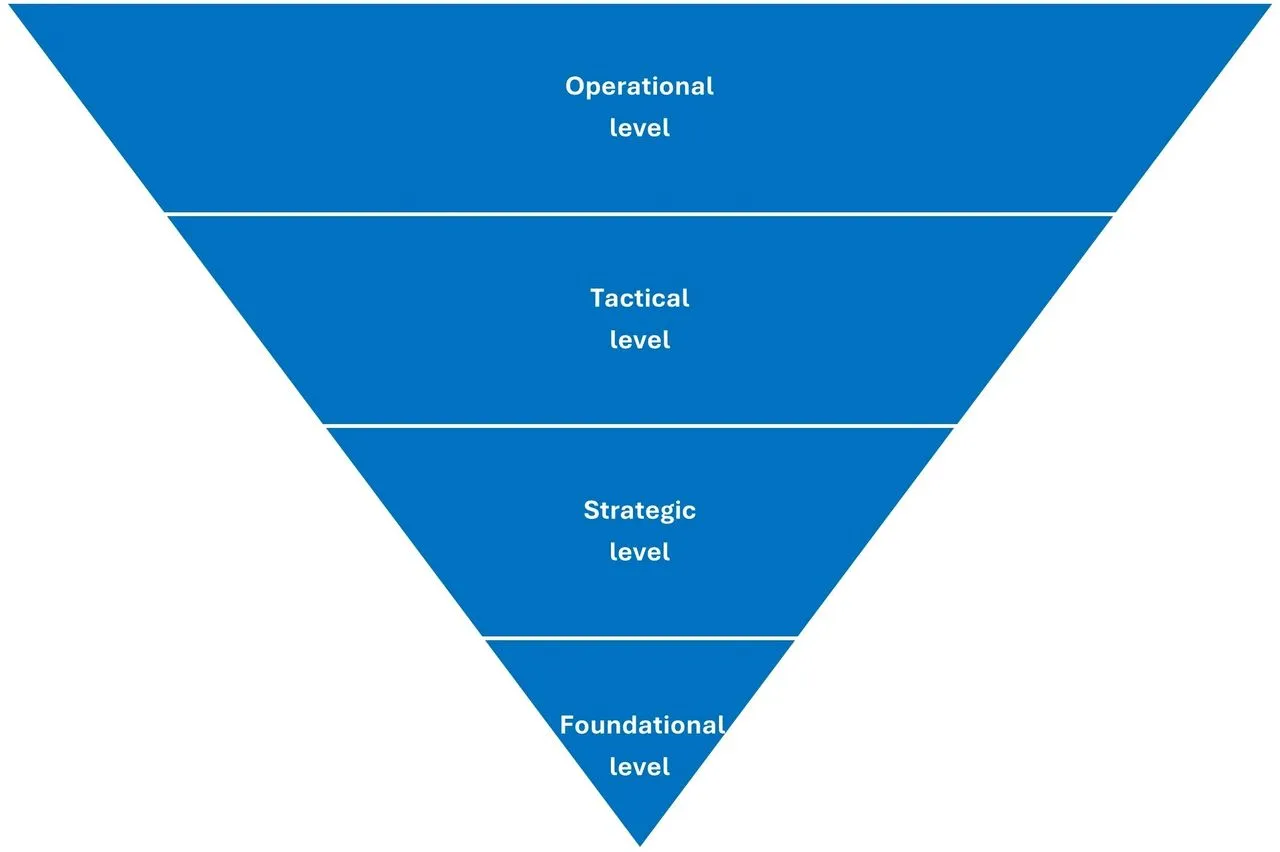
As you know by now, the premise of the holisticselling framework is to align all functions and processes to one common goal: empower your frontline team members to deliver extraordinary experiences to your customers and prospects at every moment of truth. In order to achieve success with a holisticselling mindset, we need to ensure that the company is synchronized across 4 different levels (see diagram above):
- Foundational level
- Strategic level
- Tactical level
- Operational level
Last week, we addressed the critical importance of moving forward with a holistic approach to your AI strategy in order to improve your interactions with your customers and prospects across their entire lifecycle.
This week, we will expand on how this framework needs to be deployed with purpose and consistency to drive the right tactics and capabilities across all customer-facing enterprise functions. This is meant to address 2 situations I have observed multiple times:
- The first one is when the Sales function is singled out for successes and failures. That view does not account for all the factors driving the success or failure of your B2B selling efforts (hence the need for the holisticselling framework!). Your ability to build an authentic brand, strong reputation and proven customer success depends on tuning all functions to the same frequency – thereby creating extraordinary experiences for your customers and prospects every step of the way.
- The second one is when the company comes up with a strategy but does not put in place the right tactics to help the frontline team members execute on the strategy. It leaves the frontline team members with no tools (or the wrong tools) to execute the strategy when facing customers and prospects.
Today, we will start the review of the tactical level of the holisticselling framework with your go-to-market (GTM) tactics and capabilities.
The GTM function is critical to the holisticselling framework. The GTM team needs to have the authority to guide the cross-functional alignment between Sales, Account Management, Marketing, Solution Consulting, Business Development and Sales Operations. The GTM team leader should therefore be a member of the ELT.
The primary function of the GTM team is to produce, deploy and manage the sales playbook, which is the ‘central nervous system’ of the holisticselling framework. It is made up of all the sales plays that the company will leverage to deliver extraordinary experiences and outcomes to customers and prospects.
The way you architect your sales plays will be critical to your success. Sales plays need to find the perfect match between:
- The audience you are targeting, with their business outcomes, challenges and pain points (outside-in perspective); and
- The solutions and capabilities you offer, with clear proof points (inside-out perspective).
Think about it. Customers and prospects do not care about your capabilities, they only care about solving their problems and achieving their business outcomes. That is where you need to start. On the other hand, if you uncover business outcomes and challenges you cannot successfully address, it is a waste of time for both parties – so you need to make sure you have the right solutions and capabilities that will deliver value to your customers and prospects.
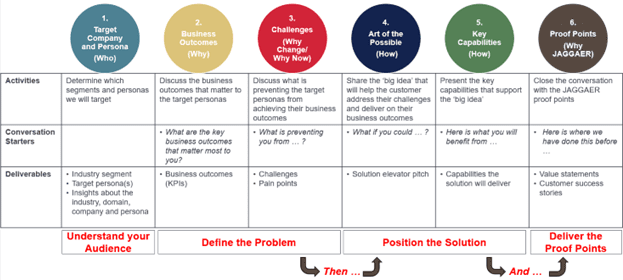
Your sales plays need to become the foundation of the conversations your frontline team members will have with customers and prospects. They follow a very specific path:
Deliver the proof points. Finally, share customer case studies and proven value numbers that match the business outcomes s/he is trying to achieve. That is a critical step in the process. This is how you land the plane. If you don’t have proof points supporting your solution, then do not create a sales play with it. If you want to market that solution, then make sure you first develop your proof points – e.g., by converting some of your customers into references and advocates, and by working with them to measure the value delivered after implementation.
Understand your audience. Determine which industry segments and personas the sales play is targeting. Leverage all the insights needed to form an opinion on the persona’s business outcomes, challenges and pain points.
Define the problem. Focus the conversation on the persona’s business outcomes first. What is s/he trying to accomplish. What are her/his goals. Then shift to the challenges that are preventing the persona from achieving her/his goals and discuss the pain points associated with these challenges. Conduct this conversation with the genuine interest of understanding how you might be able to help your customer or prospect (“stop selling, start helping”). This is where values like empathy and humility are so important. This conversation is never about you, it is always about the persona you are talking to. Focus on the problem first!
Position the solution. Once the challenges and pain points are well understood and agreed upon, share the ‘big idea’ that will help her/him address the challenges s/he is facing and achieve her/his business outcomes. Ensure that the ‘big idea’ is expressed in the form of a crisp elevator pitch that will capture her/his attention. Then expand into the capabilities supporting your ‘big idea’.
Deliver the proof points. Finally, share customer case studies and proven value numbers that match the business outcomes s/he is trying to achieve. That is a critical step in the process. This is how you land the plane. If you don’t have proof points supporting your solution, then do not create a sales play with it. If you want to market that solution, then make sure you first develop your proof points – e.g., by converting some of your customers into references and advocates, and by working with them to measure the value delivered after implementation.
See the graphic below to illustrate how to construct your sales plays:
By following this conversation flow, here is what you achieve:
- You make the customer or prospect the center of the conversation (it’s about them, not about you).
- You sell the problem, not the solution (focus on the problem as long as possible – the more time you spend on the problem and related pains, the better it is).
- You only share the ‘big idea’ once the challenges and related pain points are clearly understood.
- You connect your solution capabilities to the challenges and pains to show how you can help the customer remove them.
- You end by demonstrating to the customer that your proof points map to their business outcomes – closing the loop on why your big idea will help them achieve their business outcomes!
Much has been said about the power of storytelling. Your sales plays are the stories you want to tell – but you need to earn the right to tell them by first genuinely seeking to understand the customer’s problem or opportunity s/he cares about.
The traditional view would be to aggregate all your sales plays into a sales playbook for use by your customer-facing team members. AI will profoundly change that perspective. Once you are done building your sales plays, you will be able to load them into your company-proprietary AI LLM and then leverage your Gen AI tool of choice to interrogate the LLM and determine exactly how to conduct a tailored and relevant conversation with your customers and prospects. The result? A much higher success rate in capturing the attention of your targeted audiences.
Finally, once you have finalized your sales plays, you will fully and precisely understand the universe of industry segments and personas you need to target to maximize your B2B selling success. This will enable you to come up with your segmentation and ICP (Ideal Customer Profile) strategy. That is why you need to build your sales plays first, and then aggregate your target industry segments and personas into your segmentation strategy – from the bottom up. Many companies come up with their segmentation strategy from the top down without understanding whether they truly have the solutions and proof points to win in these segments, which is why these segmentation strategies fail!
Message #15:
- Build a dedicated GTM team that owns the production, deployment and ongoing improvement of your sales playbook. Ensure that the GTM leader is a member of your ELT.
- Build sales plays that map the audience you are targeting, with their business outcomes, challenges and pain points (outside-in perspective) to the solutions and capabilities you offer, with clear proof points (inside-out perspective).
- Once your sales plays are created, load them into your company-proprietary AI LLM.
- Leverage your AI tools of choice (e.g. ChatGPT, Claude, Copilot, Perplexity) on top of your company-proprietary LLM to enable your frontline team members to determine exactly how to conduct a conversation with a prospect or customer – on demand, one persona at a time! You can also use the same AI tools to create other forms of 1:1 communications (emails, white papers, etc.).
- Leverage the output of your sales plays to determine your segmentation and ICP strategy – that will ensure complete alignment of your GTM strategy with the solutions that will help you win!
Why is this critical to B2B selling? Because your GTM sales plays represent the foundation needed to deliver win-win touchpoints with your customers and prospects, with the goal of helping them achieve their business outcomes.
Questions for you:
- Does your company have a dedicated GTM team? Is your GTM team leader a member of your ELT?
- Do you have a sales playbook?
- Does your sales playbook consist of sales plays that map the audience you are targeting, with their business outcomes, challenges and pain points (outside-in perspective) to the solutions and capabilities you offer, with clear proof points (inside-out perspective)?
- Do you have customer success stories and value proof points for all the sales plays you have included in your playbook?
- How did you define your segmentation and ICP strategy? Have you validated that it is supported by and aligned with your sales plays?
- How advanced are you in leveraging your sales play contents in your AI LLM strategy to enable your customer-facing team members to generate tailored and relevant messages that will help them deliver extraordinary experiences and outcomes to your customers and prospects?
Next week, we will continue our review of the holisticselling tactics and capabilities. Comments welcome as usual!
Tags: