The holisticselling Newsletter
Bernard Goor
Founder and Principal, holisticselling
Published on LinkedIn on June 4, 2025
What is the holisticselling framework?
As mentioned in my blog last week, the purpose of the holisticselling framework is to align all organizational processes towards enabling the frontline team members to deliver the right outcomes to customers – at every touchpoint. My 25-year experience across 7 software companies taught me that all phases of a company’s game have to be synchronized in order to optimize its sales performance. Very often, companies make siloed decisions that impact their ability to convince customers and prospects to engage with their brands. They claim to be ‘customer-centric’ but end up making decisions that demonstrate allegiance to other priorities that detract from making their customers the heroes of their story.
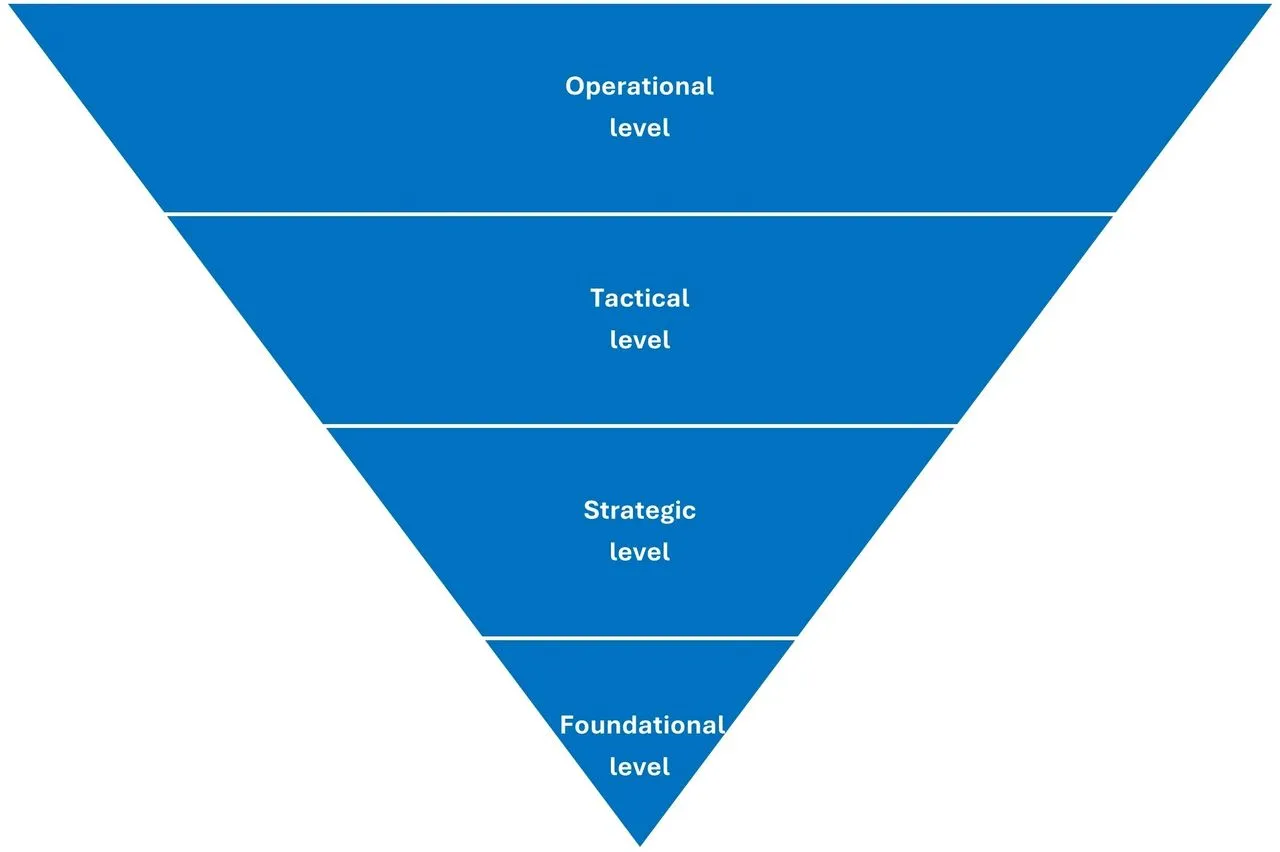
In order to achieve success with a holisticselling mindset, a company needs to be aligned at 4 different levels (see graphic above):
- Foundational level
- Strategic level
- Tactical level
- Operational level
That is the core of the holisticselling framework. These levels are organized in the form of an inverse pyramid, which puts the customers and the frontline employees at the top. It empowers employees to deliver the right outcomes to customers throughout the customer lifecycle journey.
In this article, let’s expand on the first level of the inverse pyramid: the foundational level, which is the keystone of the whole framework. It defines the culture of the company. If you don’t get the culture right, the inversed pyramid will not remain in balance. It will tilt and fall, which will impact your success – no matter what happens at the strategic, tactical or operational levels.
The foundational level includes 3 key elements that define the company culture:
- Purpose.
- Values.
- Leadership.
Let’s focus first on purpose.
The right purpose needs to be inspirational – to customers, prospects and employees. Everyone wants to be associated with a cause bigger than themselves – not a purpose focused on just growing or being profitable, but a purpose impacting something bigger – a community, a market, a movement.
That purpose is often captured by the company tagline. The problem with most taglines is that they are expressed using inside-out terms (focused on company capabilities) vs. outside-in terms (focused on customer outcomes). Let’s look at a few examples from a market I worked in over the last few years – the Source to Pay software market:
- Coupa: AI-Native Total Spend Management
- JAGGAER: Procurement Simplified
- Ivalua: All Spend, All Suppliers, One Platform
- GEP: Intelligence Drives Innovation
All 4 of them are inside-out statements focused on company capabilities. Are these statements of purpose really inspirational? Are they motivating customers, prospects and employees to engage with the brand?
By contrast, here are a few taglines that reflect an outside-in purpose and perspective:
- Blue Yonder: Fulfill Your Potential
- Kinaxis: Know Sooner. Act Faster. Remove Waste
- Microsoft: Be what’s next
- Dell: The Power To Do More
Companies that define their ‘why’, their purpose, their calling in terms of outside-in outcomes that are bigger then themselves are more likely to inspire employees, customers and prospects to engage and identify with the brand – which will power their success in the marketplace.
So – message #1: Find an outside-in, outcome-driven purpose to define your ‘why’. Seek a cause greater than yourself. Inspire your employees, customers and prospects to engage with your brand.
Now on to values.
Values represent the set of beliefs that guide how a company operates, interacts with its stakeholders and strives for success. They are essentially the principles that define the company’s culture and how it chooses to operate. Every company has a set of values, but there are 2 critical elements to making them successful:
- Are your values fundamental to the way you want your front-line employees to behave in front of customers and prospects? Values like Accountability (own your circumstances), Integrity (have strong moral principles), Transparency (be open and honest), Respect (treat everyone like you would like to be treated), Empathy (listen actively to understand), Passion (believe in what you do) and Humility (recognize your strengths and weaknesses) demonstrate your focus on how you intend to deliver the right outcomes to customers. These values will also drive internal behaviors, but the key is to choose a set of values that demonstrate your commitment to customer success. Other values, such as Adaptability, Collaboration, Agility or Excellence tend to be more focused internally and are therefore not as compelling.
- Are you applying them consistently throughout all levels of the organization? The best organizations institutionalize the use of their values by integrating them into their operations and by celebrating examples of team members living by the company values. Everyone holds everyone accountable to practice these values every day.
So – message #2: Choose a set of values that demonstrate your commitment to customer success and ensure that you integrate them into your ways of working – internally and externally.
And finally, leadership. One of the key leadership roles is to inspire, build a culture that motivates employees, customers and prospects to engage with the brand – and to consistently live by these cultural values.
Here is the message #3: As a leader, ensure that you lead by example and demonstrate the critical importance of the company purpose and values in every one of your actions – every day.
Why is this critical to B2B selling? Because purpose, values and leadership build the authenticity of the brand. If you have an inspirational and authentic brand that is based on a compelling purpose and set of values that employees practice every day to deliver extraordinary experiences to customers and prospects, you will be more successful in your B2B selling efforts. That is the foundation of everything else. It is the very tip of the upside-down pyramid. If you don’t get it right, the pyramid will tilt and fall, which will impact your success.
While this line of thinking may not be new or original, based on my experience, it is very difficult to deploy successfully. So, at the very least, it should act as a reminder that, if you don’t get your cultural foundation right, it will reduce your chances of success. That should be the first and most fundamental priority of any B2B software company.
That’s it for this week. Next week, we will start exploring the strategic level of the holisticselling framework. Feel free to share your thoughts about this week’s newsletter!
Tags: